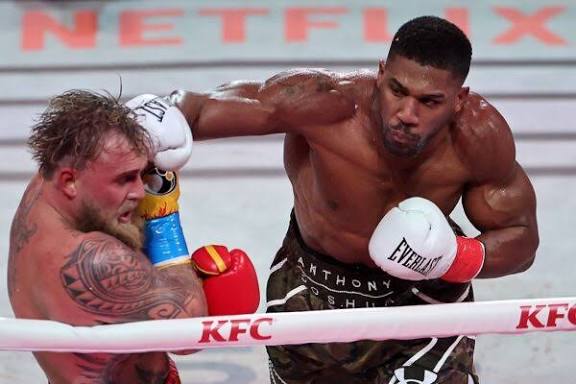
Anthony Joshua’s sixth-round knockout of Jake Paul at Hard Rock Stadium in Miami generated the largest combined purse of any boxing event in 2025, with total fighter and team earnings reported at $267 million. The figure comes from a comparative study compiled by betting company Betsson.
The event matched a long-established heavyweight in Joshua against crossover personality Jake Paul, who entered professional boxing from a social media background. Financial and audience metrics indicate that such crossover contests now occupy a central position in boxing’s commercial landscape rather than functioning as marginal attractions.
Betsson’s ranking model evaluated major 2025 fights using four metrics: online search interest, live attendance, purse size and an overall indexed score. Search data was sourced from Google Keyword Planner. Attendance and purse figures were taken from the World Boxing Association and leading sports publications, with industry estimates used where official disclosures were unavailable. The report notes that confidential contractual terms may not be fully captured.
On this basis, Terence Crawford versus Canelo Alvarez was rated the biggest fight of the year overall, with a final score of 94 points. That bout generated approximately 1.5 million online searches, drew a live crowd of 70,400 and produced an estimated $200 million purse.
Joshua–Paul ranked second overall with 90 points but led all events in purse size and search interest. The fight generated around two million online searches, the highest in the study, and a live attendance of 19,600 in Miami. Its $267 million purse was the largest of any bout measured, making it the richest event of 2025 in terms of direct fighter compensation.
Oleksandr Usyk’s rematch with Daniel Dubois placed third with a final score of 76 points. That contest recorded the largest live attendance of the year at 90,000 and a purse of $200 million, alongside approximately 135,000 online searches. While its digital footprint was smaller than that of Joshua–Paul, it remained significant for a conventional heavyweight title fight.
Chris Eubank Jr versus Conor Benn ranked fourth with 38 points, reflecting the commercial strength of domestic rivalry bouts in the United Kingdom. Katie Taylor’s trilogy fight with Amanda Serrano and Manny Pacquiao’s bout with Mario Barrios each scored 10 points, completing the top six and indicating ongoing market demand for both elite women’s boxing and veteran attractions.
From a sporting perspective, the Joshua–Paul contest functioned as a rebuilding opportunity for Joshua following his defeat to Daniel Dubois at Wembley Stadium in September 2024. In the ring, Joshua’s greater experience and power produced a methodical outcome: he used a consistent jab to control distance, applied sustained pressure and finished the fight with combinations in the sixth round. Paul entered with momentum from previous crossover bouts and a younger demographic following but was unable to offset Joshua’s technical and physical advantages.
Audience and search data suggest that Paul’s participation was a major driver of the event’s digital reach. The two million searches associated with the fight indicate a convergence of Joshua’s established boxing fan base with Paul’s younger, online-oriented audience. This aligns with a broader pattern in which influencer and crossover figures expand boxing’s total addressable market beyond traditional followers.
Commercially, the 2025 rankings show a bifurcated but interconnected ecosystem. Fights such as Crawford–Alvarez and Usyk–Dubois represent the sport’s competitive core, built around elite, legacy-defining matchups. Events like Joshua–Paul, and to a lesser extent Pacquiao–Barrios, demonstrate that the highest revenue potential increasingly lies where sporting credibility intersects with entertainment value and pre-existing digital fame.
Shortly after the Miami event, Joshua was involved in a car crash in Nigeria that resulted in two fatalities: Sina Ghami and Latif Ayodele, identified as close associates. Joshua sustained minor injuries and returned to the United Kingdom. According to statements from his uncle, Adedamola Joshua, to PUNCH Sports Extra, the incident, combined with the cumulative impact of a long career, led Joshua to decide to retire from professional boxing. If maintained, this decision would make the Paul fight his final appearance.
In that scenario, Joshua’s career profile would close with multiple world heavyweight titles, repeated stadium sell-outs and a central role in the division’s commercial resurgence. The $267 million purse attached to his last bout would serve as a quantitative indicator of how far top-end boxing revenues have expanded during his active years.
For Jake Paul, the data suggests that the loss is unlikely to diminish his market value significantly. At roughly two decades younger than Joshua and with a following that extends beyond conventional sports audiences, he remains a high-yield asset for promoters. His leading position in search interest within the Betsson study indicates that events built around his participation can continue to generate substantial digital engagement and, by extension, commercial returns.