By Abidoye Tinuoluwa Praise a 300 level Unilag Mass communication student.
Greenhouse Gases as a Global Challenge: Managing Emissions with Knowledge, Innovation, and Responsibility
We often think of climate change as a distant scientific problem, something that will affect future generations in far‑off places. But greenhouse gas emissions are not abstract figures on a chart; they are forces shaping the lived realities of billions of people today. Much like how disinformation in a pandemic can erode trust, unchecked emissions erode the very foundations of our shared environment from the air we breathe to the water we drink and the stability of our local climates.
Scholars have been clear on the urgency of this issue. The intergovernmental Panel on Climate Change (IPPC;2023)states:
“Immediate, rapid, and large-scale reductions in greenhouse gas emissions are critical to sustainable development.”
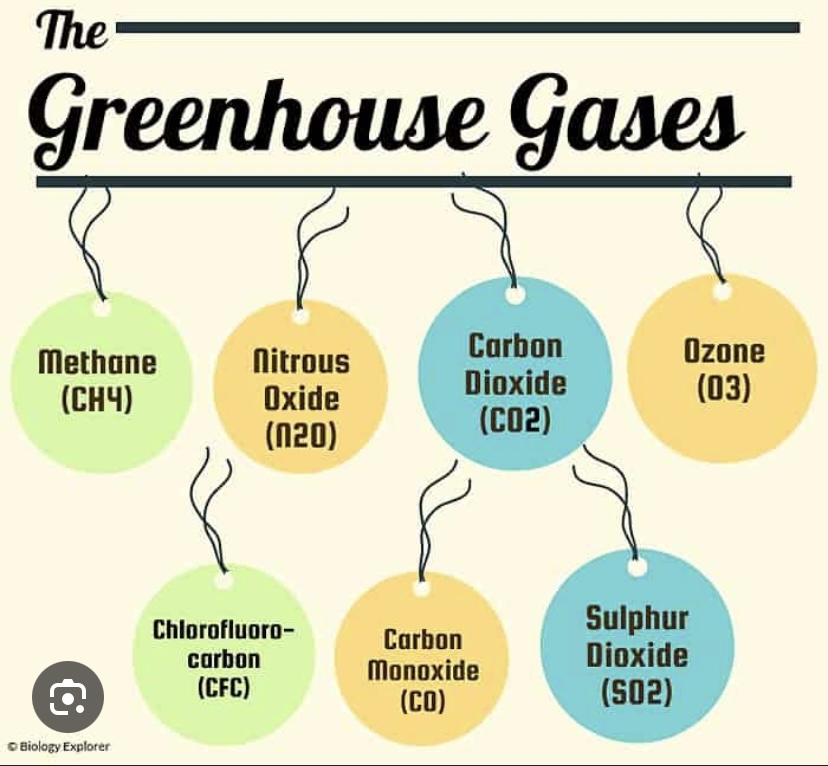
Greenhouse gases predominantly carbon dioxide (CO₂), methane (CH₄), and nitrous oxide (N₂O) act like a thermal blanket around the planet. These gases trap heat in the atmosphere, leading to warming that intensifies droughts, floods, heat waves, and sea level rise. What makes this crisis particularly complex is that these gases are by‑products of systems essential to modern society energy, industry, agriculture, and transportation .As Gregory Nement, a leading climate mitigation researcher, emphasizes:
“We have tools and strategies in each of those areas… moving away from coal and gas to clean power sources like renewables, and electrifying transportation.”
This reality calls for a shift in how we think about greenhouse gases from an abstract environmental problem to a tangible societal responsibility. It requires governance, innovation, education, and commitment at every level.
Human activities drive most of the greenhouse gas emissions today:
•Energy Production and Use: Fossil fuel combustion for electricity, heat, and transport accounts for a large share of CO₂ emissions. These emissions are deeply tied to industrial growth and economic development. Transitioning to renewable energy sources optimizes sustainability without compromising modern living standards.
•Agriculture and Land Use: Methane from livestock and nitrous oxide from fertilizer use are significant contributors to the greenhouse gas inventory. Practices such as regenerative agriculture and afforestation can simultaneously increase productivity and sequester carbon, proving that environmental management and economic viability are not mutually exclusive.
•Industrial Processes: Cement production, chemical manufacturing and waste contribute directly to emissions. Innovation in carbon capture and storage, circular manufacturing and low‑carbon materials can substantially reduce industrial footprints.
The impacts of these emissions reverberate globally: climate‑driven food insecurity, economic losses from extreme weather, biodiversity loss, and health risks are no longer forecasts; they are current realities in many regions.
From Knowledge to Action: How to Control Greenhouse Gases
To manage greenhouse gases effectively, we must reframe control from a reactive practice to a proactive strategy. This involves coordinated efforts across policy, technology, and society.
1. Policy and Governance
Strong governance mechanisms encourage accountability and innovation. The National Research Council (2020) emphasizes that:
“High quality information on greenhouse gas emissions from multiple sources and at multiple scales is needed to detect trends, verify claims about reducing emissions, and develop policies to manage carbon.”
Policies that price carbon, incentivise renewable energy adoption, and mandate transparent emissions reporting create tangible frameworks for change. Scholars demonstrate that countries with robust climate governance see faster reductions in emissions and more investment in green infrastructure.
2. Technological and Nature‑Based Solutions
Innovation is central to reducing emissions. Technologies like carbon capture, utilization, and storage (CCUS) enable industrial sectors to trap and repurpose emissions, while Energy, agriculture, and industry dominate GHG emissions. Fossil fuel combustion, industrial activity, and land-use change account for the majority of CO₂ emissions (IEA, 2022; FAO, 2021). Methane and nitrous oxide from agriculture further exacerbate the problem. As the IPCC (2023) notes:
“Most of this observed global warming is due to greenhouse gas emissions and is affecting every region of our planet.”
. At the same time, nature‑based solutions such as afforestation and soil carbon enhancement provide cost‑effective means of removing carbon dioxide while improving ecosystem health.
CALL TO ACTION :Culture, Collaboration, Commitment
Greenhouse gas management is more than an environmental necessity ,it is a moral and strategic imperative. As we increasingly experience the tangible effects of climate change, the calls for meaningful action grow louder. These calls echo across boardrooms, classrooms, parliaments, and communities. They remind us that managing greenhouse gases is not an isolated task for scientists and policymakers alone but a shared journey one that demands curiosity, courage, and compassion.
Therefore,we must align human ambition with planetary boundaries. We must foster innovation without forsaking inclusivity. We must embrace sustainability not as a slogan but as a practice deeply woven into our economic, social, and cultural fabric. In doing so, we will not only chart a path toward reduced emissions and stable climate systems, we will chart a path toward a more equitable, resilient, and hopeful future.
Thanks for reading!