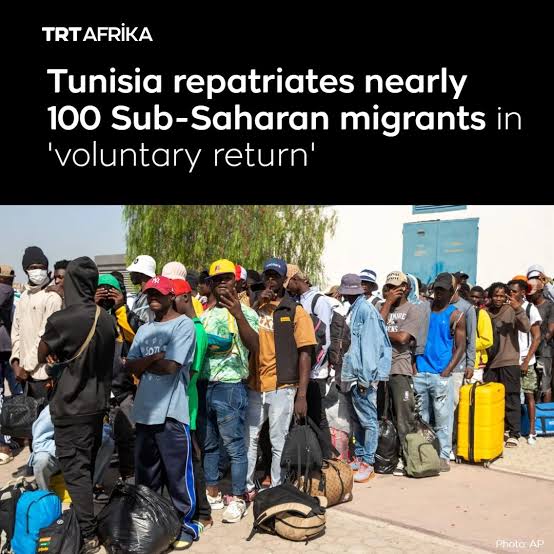
Tunisia has repatriated 91 sub-Saharan African migrants under a government-run “voluntary return” programme that authorities say has now involved nearly 5,000 people, underscoring the country’s growing role as both a migration hub and gatekeeper for Europe.
The latest group, photographed at Tunis-Carthage airport, included mostly young men wearing black masks, along with several women and children carrying backpacks and suitcases. National guard spokesperson Houcem Eddine Jebabli said the migrants were flown to multiple countries in sub-Saharan Africa.
Jebabli described the initiative, launched last July, as a scheme that “takes into account humanitarian and social aspects alongside judicial and security constraints.” According to the national guard, the pace of departures has accelerated sharply, with flights increasing from roughly monthly to what officials now call “near-daily dedicated flights.”
The programme operates separately from the International Organization for Migration’s own assisted voluntary return mechanism, which Tunisian authorities say has helped return 27,000 people over three years. Under the government scheme, migrants are urged to register through a toll-free number or via officials at a designated “voluntary return” camp.
That camp, located north of the coastal city of Sfax, serves as a screening and identification centre. Rights groups previously reported that as many as 25,000 migrants had been pushed into makeshift encampments around Sfax, often in dire sanitary conditions, after being driven out of major urban areas.
Humanitarian organisations and local activists question how voluntary the returns truly are. They have documented waves of arrests and roundups of Black Africans, with some migrants allegedly loaded onto buses and taken to undisclosed locations, including remote border zones.
The clampdown followed a speech by President Kais Saied, who claimed that “hordes of illegal sub-Saharan migrants” threatened Tunisia’s demographic balance. His remarks were widely condemned as racist and were followed by attacks on Black migrants and students, evictions and job losses.
Tunisia, alongside neighbouring Libya, remains a key springboard for people attempting the dangerous Mediterranean crossing toward Italy and other European destinations. Under pressure to curb arrivals, Tunis signed a 255-million-euro agreement with the European Union in 2023, aimed at tightening border controls and reinforcing migration management, even as questions mount over the human cost of those policies.