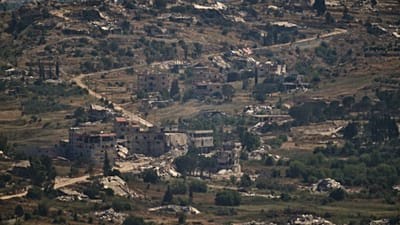
From a balcony in the Christian-majority town of Jdeidat Marjayoun, Milia el‑Cheikh scans the hills for a home she can no longer reach. Dibbine, her Shiite village a short drive away, is now a tangle of shattered concrete and barbed wire, sealed off inside an Israeli-declared military zone in southern Lebanon.
Dibbine is one of dozens of Shiite-majority communities emptied under Israeli orders as the army battles Hezbollah and entrenches itself across a wide strip of Lebanese territory. Human rights groups say Israel has barred return to at least 53 villages and towns, most of them Shiite, and has since added more to the no-go list.
What alarms many Lebanese is not only the destruction, but the pattern. While Shiite residents are ordered out on the grounds they might shelter Hezbollah fighters, many Christian, Sunni and Druze residents in nearby mixed areas have been allowed to stay. The result is a patchwork of emptied Shiite villages ringed by communities that remain inhabited but heavily controlled.
In Jdeidat Marjayoun, el‑Cheikh’s long-standing ritual of coffee with her church friend has turned into a daily reminder of loss. “Nothing is more agonizing than not being able to get to your home,” she says, watching Israeli drones buzz overhead. The town, like others on the edge of the occupation zone, lives under constant tension: sporadic shelling, sudden raids, and roadblocks that cut it off from the rest of Lebanon.
Residents say the occupation is reshaping social relations as much as geography. Local leaders in Christian and Druze towns describe receiving explicit warnings not to host displaced Shiite families, on the grounds they could be linked to Hezbollah. Many fear that obeying such orders will harden sectarian lines that had slowly softened since Lebanon’s civil war.
Streets that once carried farmers and schoolchildren now empty at dusk. Shops close early, and families sleep in interior rooms to avoid stray fire. Those who remain speak of a creeping sense of complicity: they are allowed to stay in their homes, they say, while their Shiite neighbors are turned into permanent refugees a few kilometers away.
Israel insists the buffer zone is essential for its security and has signaled it will not withdraw soon, despite international calls to wind down the fighting. For displaced Shiites like el‑Cheikh, every additional day of separation deepens the fear that the front line will harden into a sectarian border, reviving the very divisions Lebanon has spent decades trying to bury.