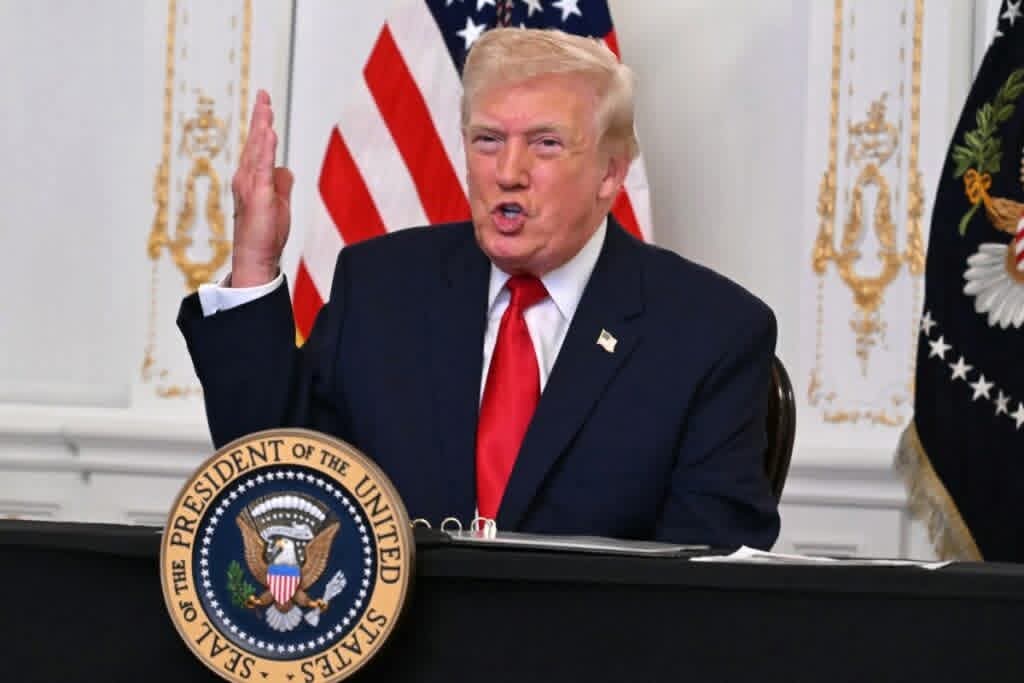
U.S. President Donald Trump’s declaration that a “massive” American naval armada was heading toward Iran marked a dramatic escalation in already fraught relations between Washington and Tehran. Speaking to reporters aboard Air Force One as he returned from the World Economic Forum in Davos, Trump described a powerful deployment of U.S. warships moving toward the region, while simultaneously hinting that the show of force might never be used.
“We have a lot of ships going that direction just in case. We have a big flotilla going in that direction. And we’ll see what happens,” Trump said, framing the move as both a precaution and a warning. He went further, casting the deployment in stark, almost theatrical terms. “We have an armada. We have a massive fleet heading in that direction, and maybe we won’t have to use it. We’ll see.”
The language was unmistakably designed to project strength. It also underscored how the U.S.–Iran confrontation had shifted from a war of words to a contest of military posturing, with both sides invoking the possibility of force while insisting they did not seek a full-scale war.
In Tehran, the response was swift and defiant. Mohammad Pakpour, chief commander of the Islamic Revolution Guards Corps (IRGC) Ground Forces, warned the United States and Israel to “refrain from any miscalculation” if they wished to avoid what he called a “more painful and regret-inducing fate.”
Pakpour emphasized that Iranian forces were on high alert and ready to respond to any attack. He said Iranian units had their “fingers on the trigger,” were “more prepared than ever,” and stood ready to carry out any order from Supreme Leader Ayatollah Ali Khamenei. The message was clear: any U.S. strike, however limited, would be met with a forceful Iranian reaction, potentially drawing the wider region into conflict.
The latest exchange came against the backdrop of intense domestic unrest inside Iran. A wave of protests had swept through cities and towns across the country, driven by economic hardship, anger at corruption, and deep frustration with the political system. The demonstrations, which began as localized grievances, quickly took on a broader, more political tone, with some protesters openly challenging the authority of the clerical establishment.
As the protests grew, so did fears that the United States might use the turmoil as a pretext for direct intervention. Those concerns were fueled by Trump’s own statements. He repeatedly urged Iranians to “take over” institutions “if possible,” and he declared that the United States was “locked and loaded” to protect protesters if Iranian security forces used heavy violence to suppress the unrest.
To many in Tehran, this sounded less like rhetorical support for human rights and more like an invitation to confrontation. Iranian officials accused Washington and its regional allies of exploiting the protests to destabilize the country and weaken the Islamic Republic from within.
The Iranian government placed particular blame on the United States and Israel for what it described as orchestrated violence during the demonstrations. Iranian Foreign Minister Seyed Abbas Araghchi argued that U.S. threats had “given plotters an incentive” to pursue a strategy of “maximum bloodshed,” suggesting that external actors were encouraging clashes in order to delegitimize the government and justify foreign pressure or even military action.
In a televised address, Supreme Leader Ayatollah Ali Khamenei went further, personally indicting Trump for the turmoil and loss of life. He said he considered “the U.S. president criminal for the casualties, damages and slander he inflicted on the Iranian nation,” portraying the unrest not as a spontaneous domestic uprising but as part of a broader campaign led from Washington.
Iranian state media sought to quantify the scale of the crisis. According to a report by the state broadcaster IRIB, 3,117 people were killed during the unrest, with 2,427 of the dead classified as “innocent civilians and security forces.” The figures, impossible to independently verify, were staggering and politically charged. By emphasizing that the majority of the dead were either bystanders or members of the security apparatus, Iranian authorities aimed to reinforce their narrative that the country had been the victim of a violent plot rather than the scene of a popular revolt.
For Washington, the protests and the Iranian response became another front in a long-running struggle over influence in the Middle East. U.S. officials have long viewed Iran as a destabilizing force, pointing to its support for armed groups across the region and its ballistic missile program. Tehran, for its part, sees the United States as the architect of sanctions and pressure campaigns designed to weaken the Islamic Republic and eventually bring about regime change.
Trump’s decision to highlight a “massive” naval deployment fit into a broader pattern of using military assets as leverage in diplomatic and political disputes. U.S. carrier strike groups and associated warships have frequently been sent to the Persian Gulf and surrounding waters during periods of heightened tension, both to reassure allies and to deter adversaries. The president’s choice of words, however, evoked historical echoes, recalling earlier episodes when American leaders spoke of “armadas” and overwhelming force to signal resolve.
Yet the president’s own caveat — “maybe we won’t have to use it” — hinted at the ambiguity at the heart of the strategy. The armada was meant to deter Iran from cracking down violently on protesters or lashing out at U.S. interests, but it also risked feeding Tehran’s fears of encirclement and invasion. In such a charged environment, the danger of miscalculation loomed large. A single incident at sea, a misread radar contact, or a clash between patrol boats and U.S. ships could spiral quickly.
Iran’s leadership, meanwhile, appeared determined to project both defiance and control. By stressing that forces were “more prepared than ever” and that orders from Khamenei would be executed without hesitation, commanders like Pakpour sought to deter any U.S. move by raising the potential cost. At the same time, officials insisted that Iran did not seek war, framing their posture as purely defensive.
The result was a tense standoff in which both sides claimed they did not want conflict, yet both continued to escalate their rhetoric and military readiness. Trump’s armada and Iran’s “finger on the trigger” became dueling symbols of a confrontation that extended far beyond the immediate crisis of protests and unrest. They reflected a deeper struggle over power, legitimacy, and security in a region where missteps can have global consequences.
As U.S. warships steamed toward the region and Iranian commanders issued warnings, the fate of the protesters who had first ignited the crisis risked being overshadowed. Their grievances — economic hardship, political exclusion, and demands for accountability — were subsumed into a larger geopolitical contest. Whether the “massive” armada would remain a symbol of deterrence or become a prelude to something far more dangerous depended on decisions made in Washington and Tehran, and on whether either side was willing to step back from the brink.