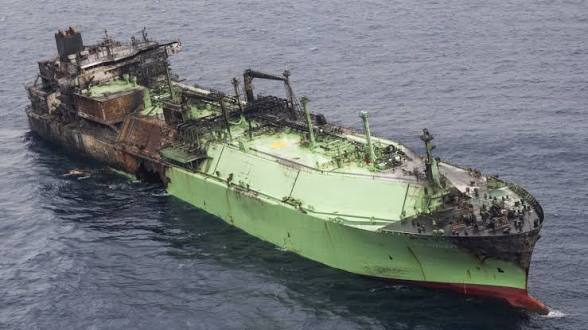
A heavily damaged Russian tanker left drifting for weeks in the Mediterranean is to be towed to a Libyan port, according to Libyan maritime authorities, in an operation that has triggered urgent environmental and geopolitical concerns across the region.
The vessel, identified as the Arctic Metagaz, is widely described by European officials and maritime analysts as part of Russia’s “shadow fleet” a loose network of ageing or obscurely registered tankers used to move oil and gas outside the reach of Western sanctions and transparency rules.
The tanker was transporting liquefied natural gas to Egypt when it was struck by a series of explosions that tore through its hull. All 30 crew members were evacuated by rescue teams, leaving the ship abandoned and slowly drifting across busy shipping lanes.
Imagery from the scene shows the Arctic Metagaz listing sharply, its superstructure scorched and two gaping holes visible on either side of the hull. Maritime safety experts warn that such structural damage, combined with a volatile cargo, significantly increases the risk of leaks or even further explosions.
Moscow has accused Ukrainian naval drones of carrying out the attack, framing it as part of a broader campaign against Russian energy infrastructure. Ukrainian officials have not publicly commented, in line with a pattern of strategic ambiguity around operations targeting Russian assets at sea.
After nearly three weeks adrift, the tanker entered Libya’s search and rescue zone, prompting coordination between Libyan and Italian authorities. Salvage specialists are preparing a towing operation aimed at stabilising the vessel and preventing any spill of liquefied natural gas or fuel residues into the Mediterranean.
Alarm over the drifting tanker has spread across southern Europe. In a joint letter to the European Commission, the leaders of Italy, Spain, Malta, Greece and Cyprus warned that the Arctic Metagaz represents an imminent and serious risk of a major ecological disaster. They called for the activation of the European Union’s civil protection mechanism to mobilise specialised equipment, vessels and technical teams.
The leaders also used the incident to highlight what they describe as systemic dangers posed by shadow fleet operations. They argue that poorly regulated tankers, often sailing under flags of convenience and skirting safety norms, threaten both maritime security and fragile marine ecosystems throughout the Mediterranean.