I used to believe football was honest.
Not the people around it, just the game itself. The ball doesn’t know your surname, your tribe, or who your uncle is. When it rolls, it rolls the same way for everybody. That was the lie that kept me running on dusty pitches under the Nigerian sun, boots torn at the sides, hope stitched tighter than the leather.
I am a local footballer. Not the kind that makes highlights or headlines. The kind you only hear about if you’re standing by the pitch and someone nudges you and says, “That boy can play.”
I grew up in a neighborhood where talent was common and opportunity was not. Every street had a Messi, every school had a Ronaldo, and every one of us had the same dream: escape. Not necessarily to Europe, just to a place where effort matched reward. Where being good was enough.
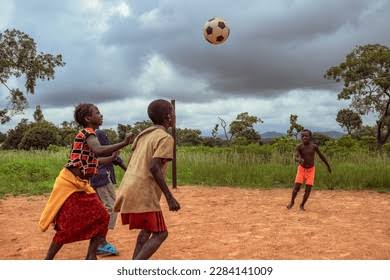
On Sunday mornings, before church bells finished ringing, we were already sweating. No kits. No medical team. No scouts with clipboards. Just us, stones for goalposts, and arguments over offside rules that changed depending on who was losing.
I learned early how to read the game, how to hold the ball, how to see passes others didn’t. People said I was intelligent on the pitch. I liked that word, intelligent. It made football feel like something more than luck.
By eighteen, I was playing for a local academy. That’s when I learned football in Nigeria has two games. One on the pitch. One behind closed doors.
The first time it hit me was during a trial. I played well, better than most. I created chances, tracked back, did the dirty work. After the match, the coach pulled me aside and nodded approvingly. Then another man pulled me aside and asked a different question.
“Who sent you?”
I laughed, thinking it was a joke. He didn’t smile.
When I said no one, his interest died immediately. By the next week, players who barely touched the ball were signed. Their only skill was connection. Someone’s son. Someone’s nephew. Someone whose parents could “support the team.”
That’s how corruption works here, not loud, not dramatic. Just quiet decisions that slowly choke merit to death.
I kept going anyway. Nigerians are stubborn like that. We are raised on endurance. We know how to suffer with style.
I played in leagues where referees were openly hostile if you didn’t “settle” them. I played matches already decided before kickoff. Once, after scoring a winning goal, the referee added six extra minutes for no reason until the other team equalized. Nobody complained. We all understood the language being spoken.
Off the pitch, life wasn’t kinder. Power outages. Transport costs rising. Friends with degrees riding okada. Parents growing older without growing richer. The country felt like a long queue that never moved, while a few people skipped ahead with smiles and bodyguards.
Sometimes I wondered if football was just a smaller version of Nigeria itself.
You work hard. You obey the rules. You believe. And still, someone else collects the reward.
The hardest part wasn’t failing to go national. It was realizing how close I came, and how little it mattered. I wasn’t worse than the players who made it. I just wasn’t connected. Talent without access is noise. It shouts, but no one listens.
There’s a special kind of grief in almost-making-it. You don’t get sympathy, because you weren’t famous enough to fall from a height. People say things like, “At least you tried,” as if trying feeds you. As if effort pays rent.
Now, I still play. Smaller pitches. Fewer dreams attached. I play because the game is the only place where I still feel like myself. When the ball comes to my feet, Nigeria disappears for a moment. No corruption. No unfairness. Just decisions, instinct, freedom.
But when the whistle blows, reality returns.
I’ve learned that life here doesn’t always reward the best, it rewards the most positioned. And yet, every evening, boys still run barefoot after plastic balls, dreaming wildly. I watch them and see myself. I want to warn them, but I don’t. Hope is dangerous, but it’s also necessary. Without it, nothing moves.
Maybe I won’t reach the national team. Maybe my name will never be sung by a crowd. But my story is not failure, it’s testimony. Proof that talent exists everywhere, even where systems are broken. Proof that corruption steals more than money; it steals futures quietly.
I am a local footballer in Nigeria. I didn’t make it big. But I made it honest. And in a country where fairness is rare, that might be the hardest trophy of all.