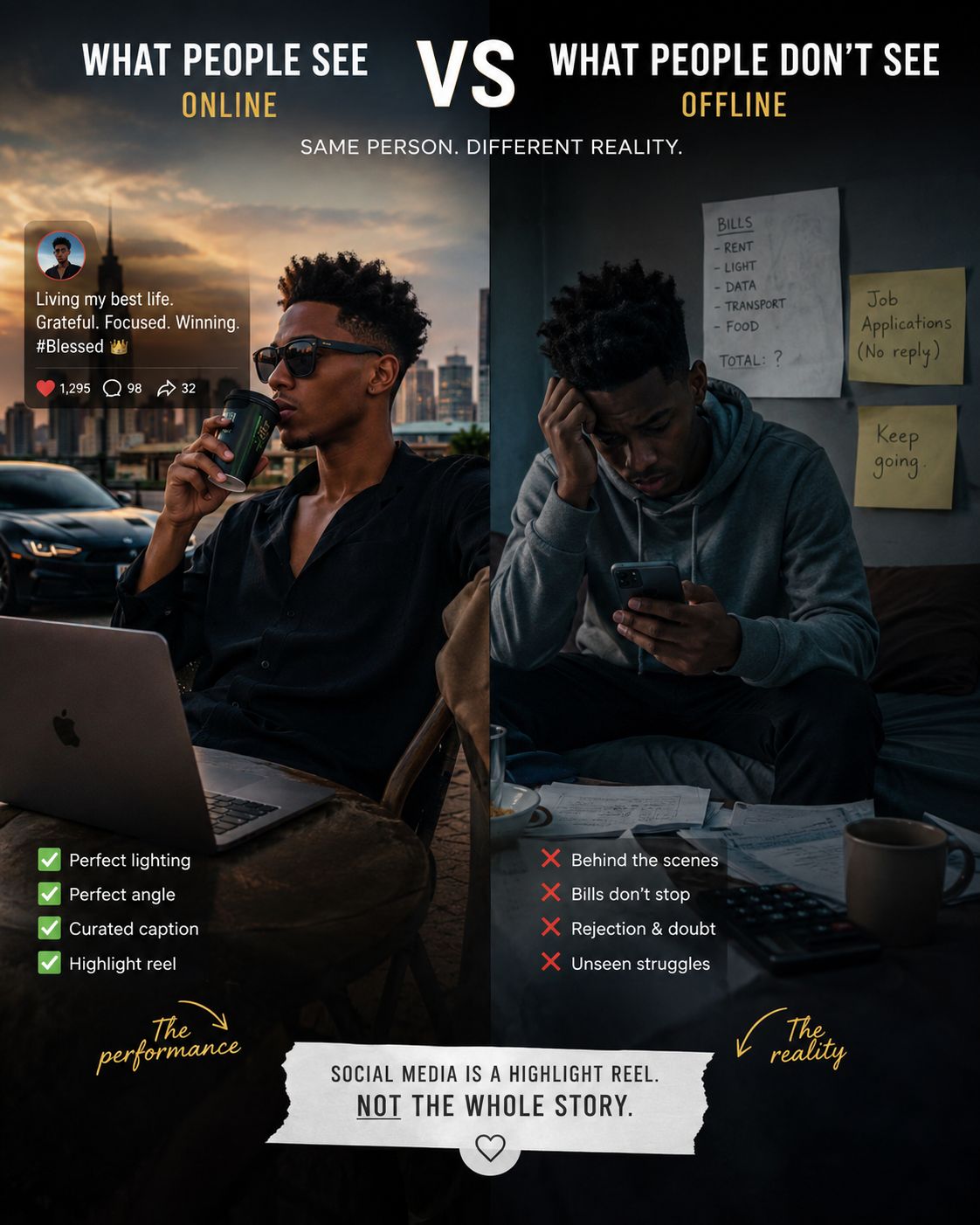
There’s a strange duality that exists in the digital age: some people look like they’ve “made it” online while quietly fighting to stay afloat offline.
On social media, success is carefully curated. A nice picture in a café becomes “soft life achieved.” A rented car becomes “new whip.” A borrowed outfit becomes “brand deal.” Even silence can be edited into mystery and perceived wealth. The internet rewards appearance more than accuracy, so people learn quickly that perception travels faster than truth.
Offline, however, life does not perform for an audience. Rent still has a deadline. Transport fares still rise without warning. Jobs still reject applications that looked perfect on paper. The same person posting motivational captions might be juggling debt, unstable income, or uncertainty about what comes next. But those realities don’t fit neatly into a 15-second reel.
Part of the reason for this gap is pressure. Social media has quietly turned comparison into a daily habit. When everyone is posting highlights, ordinary life starts to feel like failure. So people begin to edit themselves—not just their photos, but their reality. They post what looks aspirational, even when their lived experience is anything but.
There’s also the economy of attention. Visibility has become a form of currency. Many understand that looking successful can open doors that actual success hasn’t yet unlocked—opportunities, connections, validation. In that sense, online performance becomes a survival strategy, not just vanity.
But the tension between the two worlds can be exhausting. Maintaining an image of stability while living in uncertainty creates a quiet psychological load. It forces people to constantly “keep up appearances,” even when there’s nothing solid beneath them yet.
The irony is that this gap is more common than it appears. Many of the people you assume are ahead are also figuring things out in real time. The difference is not always success versus failure—it’s often visibility versus invisibility.
And maybe that’s the most important reminder: social media is not a mirror of life. It’s a highlight reel, a marketing board, sometimes even a mask. Real life is slower, messier, and far less photogenic—but it’s also where the actual story is happening.