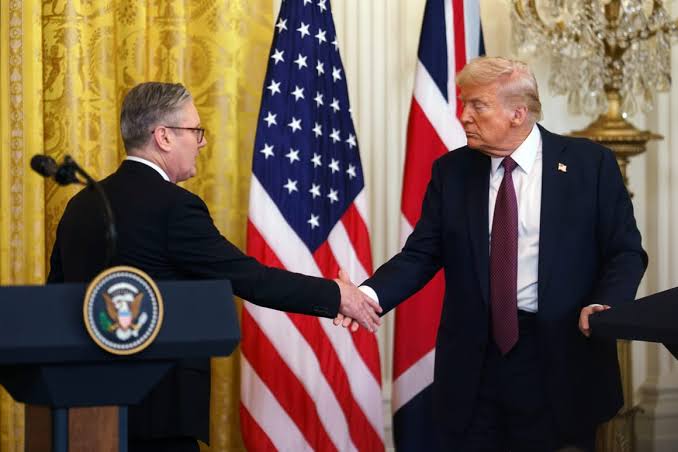
UK Prime Minister Sir Keir Starmer has accused US President Donald Trump of attempting to bully Britain into shifting its stance on Greenland, vowing in parliament that he “will not yield” to what he called a calculated campaign of pressure from Washington.
The clash, laid bare in a tense session of Prime Minister’s Questions, has exposed a deepening rift between London and Washington over the future of the vast Arctic territory, which is part of the Kingdom of Denmark but has become the latest flashpoint in a rapidly deteriorating transatlantic relationship.
Starmer told MPs that Trump’s recent remarks about the UK’s position on the Chagos Islands were not an isolated outburst but part of a broader attempt to strong-arm Britain into backing the White House’s ambitions in the Arctic.
“President Trump deployed words on Chagos yesterday that were different to his previous words of welcome and support when I met him in the White House,” Starmer said. “He deployed those words yesterday for the express purpose of putting pressure on me and Britain in relation to my values and principles on the future of Greenland. He wants me to yield on my position and I am not going to do so.”
Trump had earlier branded Starmer’s stance on the Chagos Islands “great stupidity” and coupled that criticism with threats of new tariffs on British exports. Starmer framed those comments as a warning shot aimed squarely at his refusal to endorse US designs on Greenland, a territory Trump has repeatedly and publicly coveted.
The dispute comes as Washington signals it is prepared to use economic coercion to secure greater control over Greenland’s strategic assets. Trump has threatened to impose a 10 per cent blanket tariff on imports from Britain and the European Union unless they support his push for what US officials have described as “enhanced American stewardship” over the island, which remains under Danish sovereignty with extensive self-rule.
European leaders have reacted with alarm. European Commission president Ursula von der Leyen has promised an “unflinching” response to any unilateral US tariffs, while Danish prime minister Mette Frederiksen is heading to London for urgent talks with Starmer. Diplomats say the meeting will focus on shoring up a united European front on Greenland and preventing the crisis from spiralling into a full-blown trade war.
In a frenetic 24-hour period, Trump escalated tensions with a barrage of public provocations. He threatened 200 per cent tariffs on French wine and champagne, published what he claimed were private messages from French president Emmanuel Macron, and circulated AI-generated images of himself planting an American flag on Greenland’s icy terrain. He also revived old grievances with Canada by sharing a stylised map showing swathes of Canadian territory in US colours, a move that drew condemnation in Ottawa and further unsettled NATO allies.
The spectacle has rattled Western capitals and raised questions about the stability of the postwar security order. Analysts warn that the confrontation over Greenland is not merely symbolic but touches on the core of NATO’s strategic posture in the Arctic and North Atlantic.
Chancellor Rachel Reeves, speaking from the World Economic Forum in Davos, insisted Britain would not be intimidated by tariff threats. “Britain is not here to be buffeted around,” she said. “We’ve got an economic plan. If other countries want to increase trade barriers, that is their choice.” She added that the UK’s trade deal with Washington “would not be undone” by the current row, signalling that London is prepared to absorb short-term economic pain rather than capitulate on security and sovereignty issues.
The Bank of England is closely monitoring the fallout. Governor Andrew Bailey has warned MPs that the combination of geopolitical brinkmanship and tariff threats could trigger sharp market volatility, particularly in currencies and energy prices. Officials at the central bank are said to be on “high alert” for signs of stress in bond markets and in sectors most exposed to transatlantic trade.
Within Westminster, the tone has grown increasingly grave. Shadow Cabinet minister Alex Burghart described the standoff as “the most dangerous moment for Europe since 1945”, arguing that the cohesion of NATO itself is at stake. “There’s a risk that NATO is going to fall apart,” he warned. “If it does, it will probably mean that Vladimir Putin will win in Ukraine.”
At the heart of the dispute lies Greenland, a sparsely populated island whose geopolitical importance has surged as climate change reshapes the Arctic. Its location between the Arctic Ocean and the North Atlantic makes it a natural hub for missile defence, satellite tracking and emerging shipping lanes that could shorten global trade routes as sea ice retreats.
Greenland hosts Pituffik Space Base, formerly known as Thule Air Base, the United States’ northernmost permanent military installation. The facility is a key node in America’s ballistic missile early-warning system and space surveillance network. The island is also believed to hold significant deposits of rare earth minerals and other critical resources essential for advanced electronics, renewable energy technologies and modern weapons systems.
Security experts note that the United States already enjoys extensive access to Greenland’s facilities under existing defence agreements with Denmark. However, Trump has folded the island into his ambitious “Golden Dome” missile-shield concept, portraying it as “vital” to a reinforced early-warning and interception architecture stretching across the Arctic. That framing has alarmed European officials, who fear that Washington is seeking de facto control over Greenland’s defence and resource policy, sidelining both Copenhagen and Brussels.
For Starmer, the Greenland dispute has become a defining test of his foreign policy doctrine: a blend of Atlanticism and European alignment, underpinned by a stated commitment to international law and multilateralism. His refusal to bend to Trump’s demands marks his sharpest public criticism of the US president since entering Downing Street.
He has condemned the tariff threats as “completely wrong” and privately urged allies to avoid being drawn into what one senior official described as “a transactional auction over territory and security”. Opposition parties and some backbenchers, however, are pressing him to go further by convening an emergency summit on Arctic security, bringing together NATO members, Nordic states and Greenlandic representatives to clarify red lines and prevent miscalculation.