There's an unspoken rule many of us grew up with: real men don't complain about pain. You push through. You manage. You tell yourself it will pass.
And it does pass until one day, it doesn't.
The kidneys are one of the quietest organs in the human body. They filter over 200 litres of blood every single day, regulate your blood pressure, control fluid balance, and remove waste. They do all of this silently, without asking for acknowledgment.
That silence is also their danger.
By the time kidney disease shows symptoms: swollen feet, fatigue, reduced urination, foamy urine, significant damage may already have occurred. The kidneys can lose up to 60–70% of their function before a person feels noticeably unwell. That's not a glitch in the system. That's a warning we are designed to miss if we aren't actively paying attention.
Beyond the kidneys, there are several organs men routinely neglect:
The Heart: Heart disease remains the leading cause of death among men globally, yet most men have never had a basic ECG or lipid profile done. High blood pressure, nicknamed "the silent killer" often has no symptoms until it causes a stroke or heart attack.
The Liver: Alcohol, processed foods, and undiagnosed hepatitis are quietly damaging millions of livers across Nigeria. The liver regenerates, but only up to a point.
The Prostate: After age 40, every man should have a conversation with a doctor about prostate health. PSA screening is simple. Prostate cancer caught early is highly treatable. Caught late, it isn't.
The Kidneys: Diabetes and hypertension, both increasingly common in Nigeria are the two leading causes of chronic kidney disease. If you have either condition and you're not monitoring your kidney function regularly, you are gambling with your life and your family's finances.
What a Hospital Admission Actually Costs
I'm not just talking about money, though the money is real and devastating.
I'm talking about the cost of watching a strong man become dependent. The cost of disrupted plans, halted businesses, children missing school because fees were redirected to treatment. The cost of a family holding its breath.
Healthcare in Nigeria is overwhelmingly out-of-pocket. There is very little safety net. A two-week admission for a serious condition can and does wipe out years of savings. I have seen it. My family is living it right now.
Prevention is not just a health decision. It is a financial strategy.
What You Can Do - Starting This Week
You don't need to overhaul your life overnight. Start here:
1. Book a comprehensive health check: A full blood count, kidney function test (KFT), liver function test (LFT), blood pressure check, blood sugar (fasting), and urinalysis. In most Nigerian cities, this costs between ₦15,000 and ₦40,000. Compare that to what treatment costs.
2. Drink more water: The kidneys need adequate hydration to function. Most Nigerian men are chronically underhydrated, especially those working outdoors or in physically demanding roles.
3. Reduce your salt intake: Excess sodium raises blood pressure and strains the kidneys. This doesn't mean eating bland food, it means being conscious.
4. Cut back on self-medication: NSAIDs like ibuprofen and diclofenac, taken repeatedly without medical supervision, are a leading cause of kidney damage. The painkiller you take casually every week is not as harmless as you think.
5. Know your numbers: Blood pressure. Blood sugar. Creatinine levels. These are not just hospital jargon, they are the early warning signals your body is trying to send you. Learn what they mean.
6. Talk to other men about this: Health silence is a cultural habit. Break it. Your father did not talk about his health. Maybe your grandfather didn't either. You can be the one who changes that pattern for your children.
A Final Word
My father is a strong man. He raised his family, built what he could, and never complained. I respect everything he has carried.
But I wish someone had sat him down twenty years ago and said: your body is an asset. Maintain it the way you maintain your car, your house, your business.
I'm saying it to you now.
Don't wait for a crisis to start caring. Don't let your family's savings be the price of your silence.
Go and check yourself. Do it for the people who need you here.
Two weeks ago, my father was admitted to the hospital.
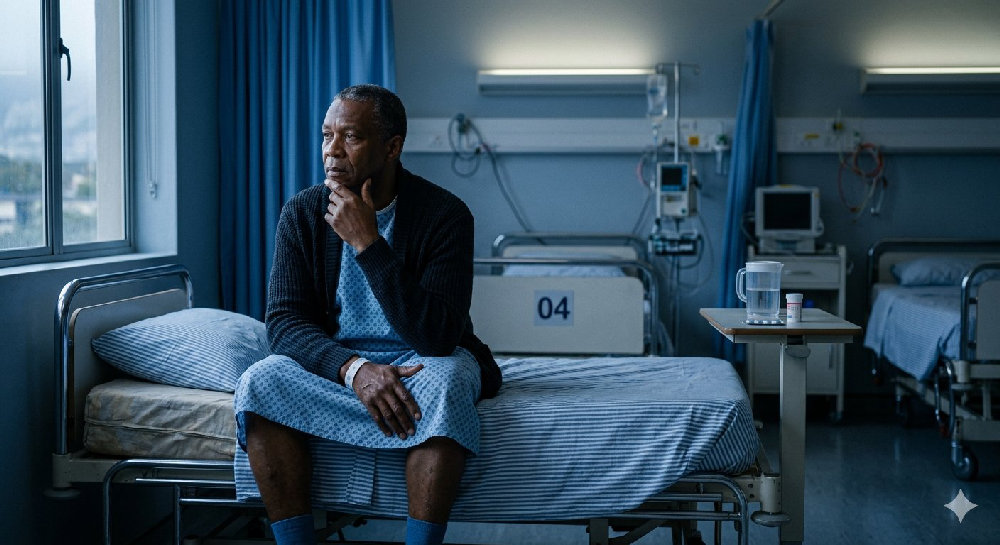
He's been lying on that bed in a ward with blue walls, under a mosquito net, with a drip running into his arm for fourteen days now. And in those fourteen days, over five years of his savings and mine have been wiped out.
Five years.
He didn't spend those years being lazy. He worked. He sacrificed. He planned. And in two weeks, a body he never paid attention to took it all back.
I'm writing this because I don't want you to end up in that bed. And I especially don't want your children to stand where I'm standing right now.
9