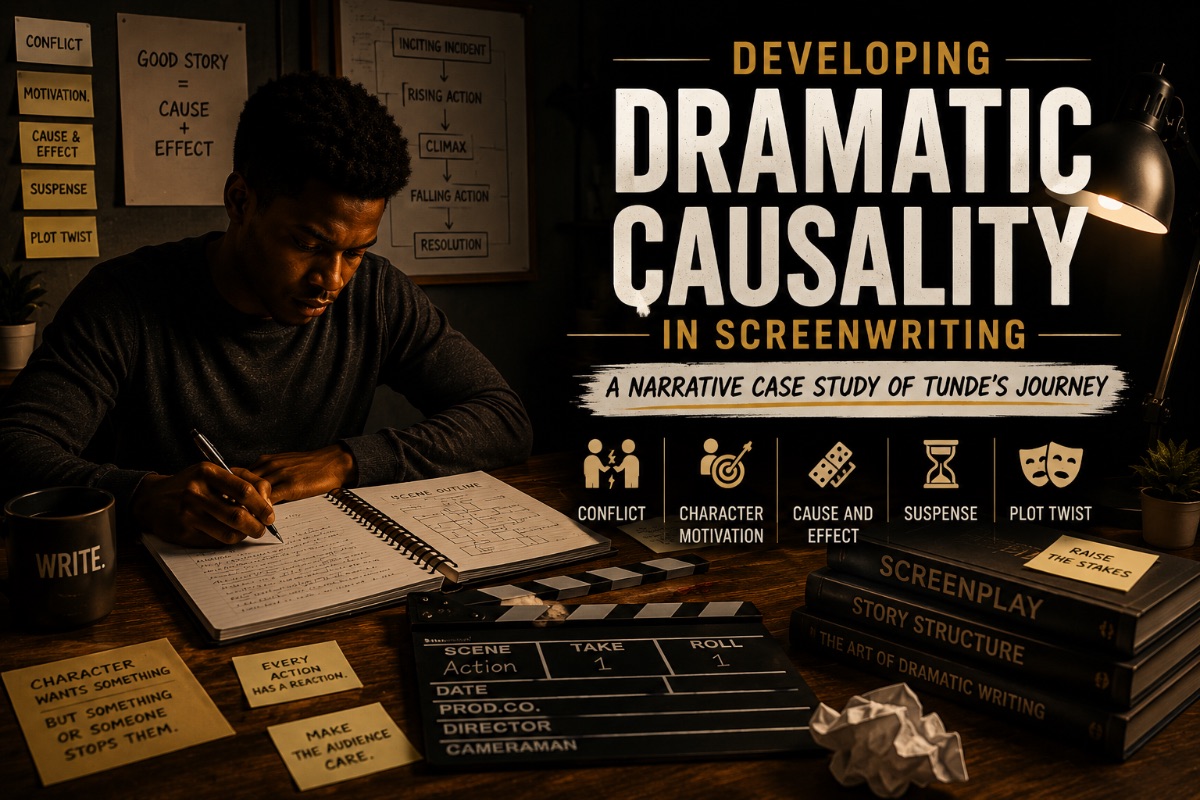
One of the most important aspects of screenwriting is dramatic causality. Dramatic causality refers to the logical relationship between events in a story, where one action leads to another and every event has a cause and an effect. Without dramatic causality, a screenplay becomes a collection of unrelated scenes that fail to engage the audience. To understand how dramatic causality helps a screenplay progress, this discussion follows the story of a young screenwriter, Tunde, who learns five important tools that transform his weak script into a compelling screenplay.
Tunde was a final-year Theatre Arts student who dreamed of becoming a successful screenwriter. One day, his lecturer assigned the class to write a short screenplay. Excited by the opportunity, Tunde spent several days developing his story. However, when he submitted his first draft, the lecturer remarked that although the story contained interesting scenes, the events lacked connection. Characters appeared and disappeared without reason, and important incidents seemed random.
Determined to improve, Tunde sought advice from an experienced filmmaker who introduced him to five essential tools for developing dramatic causality in a screenplay.
Conflict: The Foundation of Dramatic Action
The filmmaker first explained that every screenplay requires conflict. Conflict is the struggle that drives characters into action and creates movement within the story.
Applying this lesson, Tunde created a protagonist named Emeka, a young graduate struggling to find employment. Emeka’s inability to secure a job became the central conflict of the story. Because of this problem, he was forced to attend interviews, seek help from friends, and make difficult decisions. The conflict therefore became the cause of subsequent events and established the foundation for dramatic progression.
Character Motivation: The Reason Behind Every Action
The second tool was character motivation. According to the filmmaker, audiences must understand why characters act the way they do.
In Tunde’s screenplay, Emeka’s motivation was to rescue his family from financial hardship. His father’s illness and his mother’s inability to provide for the family compelled him to accept a job offer from a wealthy businessman. This decision was not accidental; it was motivated by his circumstances. Through character motivation, Tunde ensured that every action taken by Emeka was believable and logically connected to the plot.
Cause and Effect: The Engine of Story Progression
The filmmaker then introduced cause and effect, describing it as the engine that drives dramatic causality.
Soon after accepting the job, Emeka discovered that his employer was involved in fraudulent activities. Because he discovered this secret, he became a threat to the businessman. Consequently, he began receiving warnings and threats. Each event resulted directly from the previous one. Emeka’s decision to take the job led to the discovery of corruption, which in turn led to danger and confrontation. This chain of cause and effect created a coherent and engaging storyline.
Suspense: Sustaining Audience Interest
The fourth tool was suspense. The filmmaker explained that suspense keeps audiences emotionally invested by making them eager to know what happens next.
As the story progressed, Emeka secretly gathered evidence against his employer. However, he was uncertain whom he could trust. Unknown individuals followed him, and mysterious phone calls increased his fear. The audience would naturally wonder whether Emeka would succeed in exposing the truth or become a victim of the corrupt businessman. This uncertainty generated suspense and maintained dramatic tension throughout the screenplay.
Plot Twist: Creating Surprise and Emotional Impact
Finally, the filmmaker discussed the importance of plot twists. A plot twist introduces an unexpected development that alters the audience’s understanding of the story.
In Tunde’s screenplay, Emeka eventually discovered that his closest friend, whom he trusted completely, was secretly working for the businessman. This revelation shocked both the protagonist and the audience. More importantly, the twist emerged from previous events rather than appearing suddenly without explanation. The plot twist intensified the conflict and increased the emotional impact of the story.
Through his journey as a screenwriter, Tunde learned that dramatic causality is essential for creating an effective screenplay. By employing conflict, character motivation, cause and effect, suspense, and plot twists, he transformed a disconnected script into a compelling narrative where every event logically led to the next. These five tools not only ensure the progression of a screenplay but also enhance audience engagement, emotional investment, and overall storytelling quality. Therefore, they remain indispensable elements in the development of any successful screenplay.