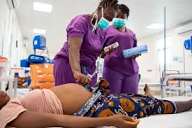
When Cynthia returned to Lagos University Teaching Hospital, Idi-Araba, for antenatal care with a twin pregnancy barely seven months after her first delivery, doctors were clear: she would need a caesarean section.
She braced herself for surgery. What she did not anticipate was the bill.
On the eve of her operation, she paid over N253,000 just to secure a bed on the ward. After the procedure, further payments of N70,000 and N127,312 were demanded before discharge. By the time she added consumables and drugs bought outside the hospital, Cynthia estimated she had spent about N1.3m to have her twins at a federal teaching hospital that, on paper, should already be offering free caesarean sections to indigent women.
“We should be able to benefit from one or two things from the government,” she said. “If we must be charged at government hospitals, it should be minimal so that even the lowest of all can afford it.”
Her experience underscores a stark reality: one year after the Federal Government unveiled the Comprehensive Emergency Obstetric and Newborn Care initiative, many pregnant women in the South-West still pay out of pocket for life-saving surgery at flagship federal centres.
At LUTH, the supposed free CS scheme is virtually unknown. Pregnant women at antenatal clinics said they had never been informed of any such programme. Nurses and social workers also expressed ignorance, with one senior nurse insisting, “There is nothing like free CS in federal hospitals in the South-West here. You will have to go to the north to access such a service.”
Officials at the hospital’s corporate services unit confirmed that discussions with the Federal Ministry of Health were ongoing but said the programme had not started.
In Ibadan, the University College Hospital, which signed an agreement to participate in the scheme, has also not rolled it out. The Head of Obstetrics and Gynaecology, Prof Christopher Aimakhu, explained that the intervention is limited to selected high-poverty areas and cannot realistically cover every woman in every federal hospital. He warned that declaring universal free CS without sustainable funding could cripple services.
Meanwhile, other regions are moving ahead. Teaching hospitals in Sokoto, Akwa Ibom, Rivers and parts of the South-East report hundreds of indigent women benefiting from free emergency caesarean sections, funded through the National Health Insurance Authority.
For women in Lagos, Ibadan and Abeokuta, however, the promise remains largely theoretical. As maternal mortality stays stubbornly high and CS costs in federal hospitals climb towards N700,000 in complicated cases, the gap between policy and practice is measured in lives, not just naira.