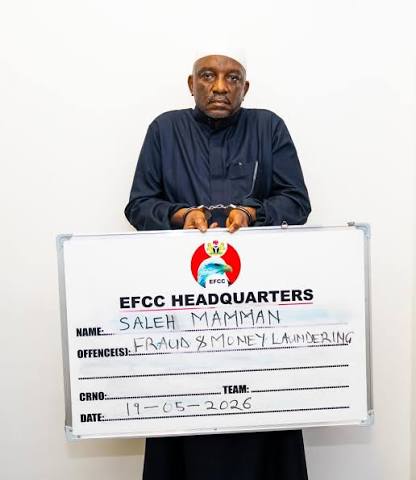
Former Nigerian minister of power Saleh Mamman has been arrested after days on the run, following his conviction and 75-year prison sentence for large-scale corruption tied to major electricity projects.
The Economic and Financial Crimes Commission EFCC confirmed that its operatives picked up Mamman in Kaduna state after what officials described as weeks of discreet surveillance and intelligence-led tracking. He was reportedly moved under heavy security to Abuja, where he is expected to be processed into the correctional system to begin serving his term.
Mamman had vanished from public view after a Federal High Court in Abuja found him guilty on 12 counts of money laundering and diversion of public funds. The charges stemmed from contracts for two hydroelectric power projects, part of Nigeria’s long-promised but repeatedly delayed efforts to stabilise its national grid.
The court ruled that prosecutors had proved beyond reasonable doubt that at least 22 billion naira meant for critical power infrastructure was siphoned through proxy companies and associates linked to the former minister. The judge ordered that the sentences on each count run consecutively, resulting in a cumulative 75-year term.
EFCC chairman Ola Olukoyede said the arrest underscored the agency’s resolve to ensure that high-profile convictions are not reduced to “paper judgments.” He framed the case as a test of Nigeria’s willingness to confront entrenched graft in its energy sector, long seen as a black hole for public funds.
Mamman, who served as power minister from 2019 to 2021 under former president Muhammadu Buhari, also faces a separate corruption trial in Abuja over alleged misappropriation of an additional 31 billion naira. A different court had earlier issued a warrant for his arrest after he failed to appear for that proceeding.
The scandal has reignited public anger over Nigeria’s chronic electricity crisis. Despite vast oil and gas reserves and decades of reform pledges, the country continues to endure rolling blackouts, with many homes and businesses relying on expensive generators. Critics say the Mamman case illustrates how systemic corruption has undermined investment, delayed projects and left millions without reliable power.
Rights groups and anti-corruption advocates are now watching closely to see whether the conviction and arrest will be followed by asset recovery, compensation to the state and tighter oversight of future power-sector contracts.