COMMENTARY
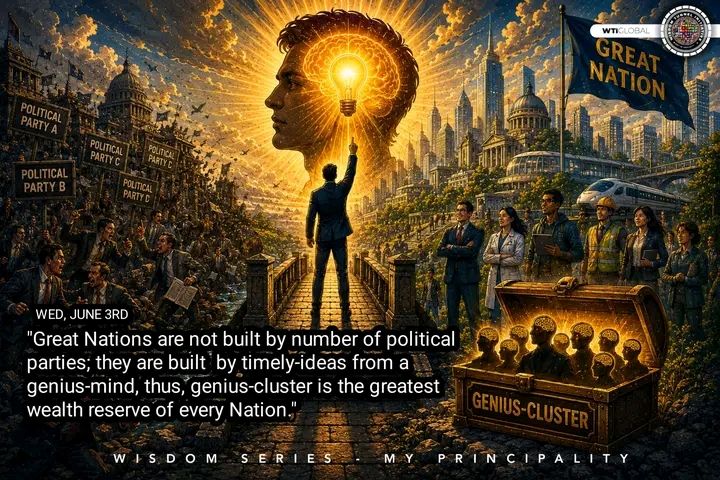
Great nations are not built by the number of political parties. This is a statement most Nigerians have failed to understand and still misunderstand even today.
In 2013, four political parties in Nigeria—namely the ACN, CPC, ANPP, and a faction of APGA—merged to form the APC. In 2015, the party emerged as the major opposition to the PDP, which, at the time, was Nigeria's dominant political party.
The main theme of the APC that year was "Change," and they were able to sell this message perfectly to the masses. Nigeria's economy had declined somewhat during that period, although the deterioration had not escalated to its present level. One thing, however, was clear: the masses had had enough, and they wanted change.
What many failed to ask were important questions:
What is change?
What does it take to make a nation great?
The masses were less concerned about the mindset and vision of the political contestants. Instead, they were more concerned with the transfer of power and authority from one party to another because they believed that such a transfer would automatically bring transformation to the nation.
In the end, the APC won. However, to many people today, that victory may have become one of the greatest disappointments in Nigeria's democratic journey.
From this brief history, one thing is clear: nations do not rise to greatness based on the number of available political parties. Rather, they rise on the strength of timely ideas generated by exceptional minds.
Many people criticize a two-party system, arguing that it limits voter choice and marginalizes smaller groups. Yet, for decades, both the United Kingdom and the United States have operated under systems largely dominated by two major political parties, and their economies are far stronger than Nigeria's.
I do not intend to compare Nigeria with Britain or the United States. Neither do I intend to advocate for a two-party system. My primary objective is to establish a simple fact:
A multi-party system is not the key to unlocking national greatness.
Rather, the key lies in the quality of ideas generated by the most innovative and visionary minds within a nation.
The Greatest Wealth Reserve of Any Nation
This brings us to what I consider the greatest wealth reserve of any nation: the genius cluster.
When many people hear the phrase wealth reserve in relation to countries, they immediately think of mineral resources such as oil, gold, diamonds, or natural gas. However, I would argue that the greatest wealth reserve of any nation is not its mineral resources but its genius cluster.
If mineral resources alone guaranteed greatness, then Nigeria should already rank among the world's most prosperous nations.
What Is a Genius Cluster?
A genius cluster is a concentration of exceptionally talented, creative, innovative, and intellectually gifted individuals who exist in the same place and time, and whose interactions produce extraordinary achievements.
One historical example can be found in ancient Athens during the era of Socrates, Plato, and Aristotle. Their intellectual contributions shaped philosophy, science, politics, and education for centuries.
The lesson is simple:
National greatness is not determined by the abundance of resources but by the quality of ideas capable of transforming those resources into prosperity.
Consider countries such as:
Japan
Singapore
South Korea
Switzerland
Hong Kong
Taiwan
These nations possess limited natural resources. In fact, some of them, particularly Singapore and Hong Kong, have virtually no significant mineral resources at all.
Yet, as much as many may dislike admitting it, these countries enjoy stronger economies, higher living standards, and better infrastructure than resource-rich nations such as Nigeria, Venezuela, and the Democratic Republic of Congo.
This reality demonstrates a profound truth:
The abundance of resources in the absence of a genius cluster is still poverty.
Therefore, the greatest wealth reserve of any nation is not what lies beneath its soil but the genius cluster that exists within its people.