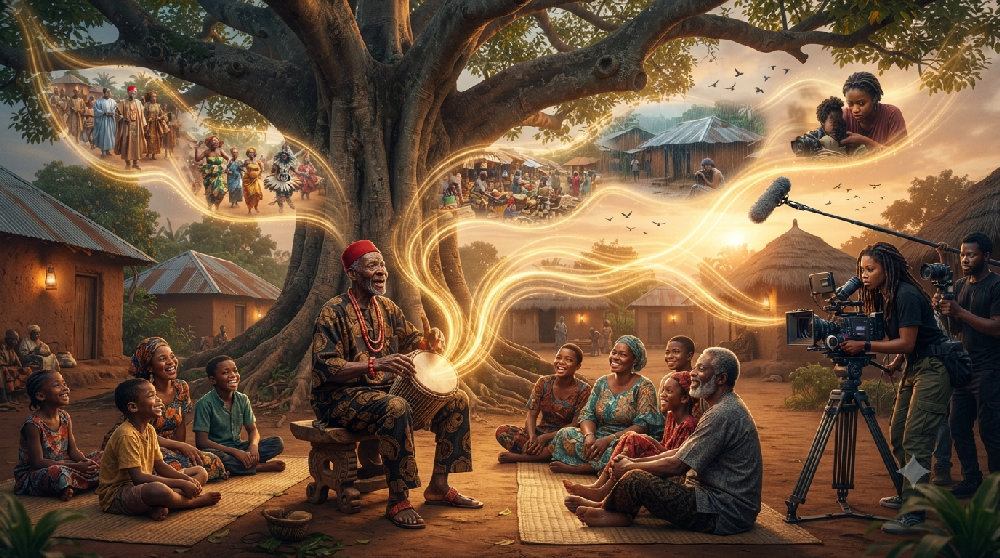
Many years ago, in the quiet village of Umuagu, there lived an old storyteller named Papa Nwosu. Every evening, as the sun disappeared behind the hills, children and adults gathered under the ancient iroko tree to listen to his stories. Unlike many storytellers, Papa Nwosu always began his stories with sound before saying a single word.
He would beat a small talking drum three times.
Gboom… Gboom… Gboom…
Immediately, everyone became silent.
Without seeing anything, the children already knew that an important story was about to begin. The sound of the drum had spoken before the storyteller did.
One evening, a young boy named Chinedu asked him,
“Papa, why do you always beat the drum before telling a story?”
The old man smiled and replied,
“My son, long before people learned to read books, Africa was already telling stories with sound. A drum can announce joy, danger, celebration, or war without saying a single word. Sound speaks to the heart before words reach the ears.”
Years later, Chinedu left the village to study filmmaking at the university. During one of his classes, his lecturer asked the students to explain the importance of sound in modern African cinema.
While other students talked about microphones, speakers, and editing software, Chinedu remembered the words of Papa Nwosu.
After graduation, he decided to produce his first film based on his village.
As filming began, he realised that the camera alone could not tell the whole story.
When the village chief was about to appear, he added the sound of traditional talking drums before the audience saw him. Immediately, viewers understood that someone important was arriving.
When farmers worked on their land, he included the sounds of hoes striking the ground, birds singing in the trees, goats bleating nearby, and children laughing in the distance. These simple sounds made the village feel alive.
One emotional scene showed an elderly mother waiting for her son, who had travelled to the city many years earlier. She sat quietly outside her house every evening, hoping he would return.
There was almost no dialogue.
Instead, soft flute music played in the background while the evening wind gently rustled through the trees. The audience could feel her loneliness without her saying much.
Later in the film, tragedy struck.
News arrived that the young man had died in a road accident.
Before anyone announced the news, the audience heard women crying in the distance, followed by the slow beating of the village drum.
The entire cinema became silent.
Many people watching the film wiped tears from their eyes. It was not only because of what they saw, but because the sound allowed them to experience the family’s pain.
When the film reached the climax, the annual New Yam Festival was celebrated.
Traditional songs filled the air.
Masquerades danced to the rhythm of local drums.
Women sang cultural songs while children clapped happily.
The audience could almost feel as though they were standing inside the village square.
The sounds did more than entertain; they preserved the community’s culture and identity.
After the film was released, many people praised its beautiful storytelling.
One elderly man approached Chinedu and said,
“Your camera showed us the village, but your sound made us feel like we were living inside it.”
Chinedu smiled because he finally understood what Papa Nwosu meant years ago.
In African storytelling, sound is not just something people hear.
It is a language.
It tells stories.
It carries emotions.
It preserves culture.
It warns of danger.
It announces celebration.
It creates suspense.
It connects generations.
Today, modern African filmmakers still use this same principle.
Although they now have digital cameras, professional microphones, editing software, surround sound systems, and streaming platforms, the heart of African cinema remains the same. Sound continues to breathe life into every story.
Whether it is the sound of talking drums, church bells, market women calling customers, children playing in dusty compounds, rainfall on zinc roofs, or traditional songs sung during festivals, every sound adds meaning to the story.
A beautiful picture may capture the audience’s eyes, but meaningful sound captures their emotions.
That is why motion picture sound remains one of the most powerful tools in modern African cinema. It transforms ordinary scenes into unforgettable experiences and allows African stories to be felt as deeply as they are seen.
The story of Chinedu reminds us that filmmaking is more than recording images. Great films communicate through both sight and sound. In modern African cinema, sound gives life to stories, strengthens emotions, preserves traditions, and creates a lasting connection between the audience and the characters. Just as Papa Nwosu’s drum spoke before his words, sound continues to tell African stories in ways that pictures alone never could.
7