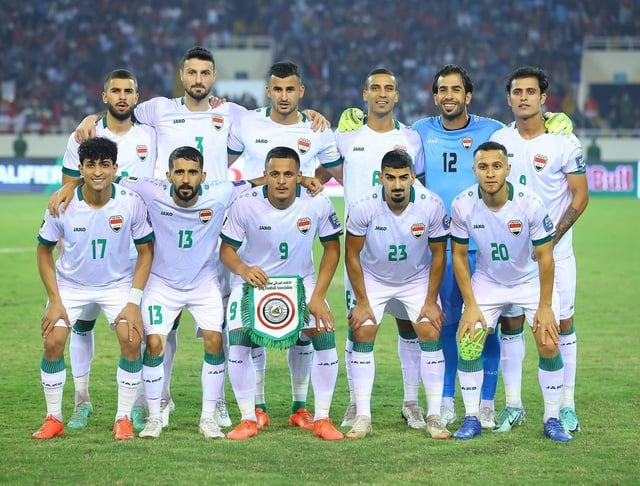
Iraq’s football federation has formally requested that FIFA postpone the nation’s intercontinental World Cup play-off, citing regional conflict and associated airspace closures as primary operational constraints on assembling the strongest possible squad.
Head coach Graham Arnold, an Australian appointed to lead Iraq’s national team, stated that the current security situation, linked to US-Israeli military action and Iranian retaliation, has significantly disrupted normal air travel. With Iraqi airspace closed and flights across parts of the Middle East affected, players and staff based in Iraq face substantial logistical barriers to reaching the scheduled venue in Monterrey, Mexico.
Iraq is scheduled to face the winner of a semi-final between Bolivia and Suriname. The play-off will determine a single qualifying place for the 2026 World Cup in the United States, Mexico and Canada. For Iraq, this fixture represents an opportunity to return to the World Cup for the first time in approximately 40 years.
Arnold has argued that proceeding under current conditions would likely require him to select a squad composed largely of players based outside Iraq, due to travel restrictions affecting those within the country. He contends that this scenario would undermine both competitive balance and the expectations associated with a match of this magnitude.
He has stated that the team would not be representative of Iraq’s best available players and has linked this to the significance of the match, which he describes as the country’s most important in four decades. He has also noted that football has historically functioned as a unifying activity in Iraq, which has experienced prolonged periods of conflict and political instability.
Iraq advanced to this stage by defeating the United Arab Emirates 3-2 on aggregate in the fifth round of Asian qualifying. That result has been interpreted within Iraqi football circles as evidence that a new generation of players may be capable of matching the achievements of the national team of the 1980s. Federation president Adnan Dirjal is seeking a short postponement from FIFA, arguing that rescheduling the match until travel conditions stabilise would enhance the fairness of the competition.
Arnold has proposed a compromise in which Bolivia and Suriname would play their semi-final as scheduled, while Iraq’s decisive play-off would be moved closer to the start of the World Cup, potentially in the United States. Under this proposal, the winner would already be in or near the host region ahead of the tournament. FIFA’s decision on Iraq’s request will determine whether the fixture proceeds as planned or is adjusted in response to the current security and travel environment.