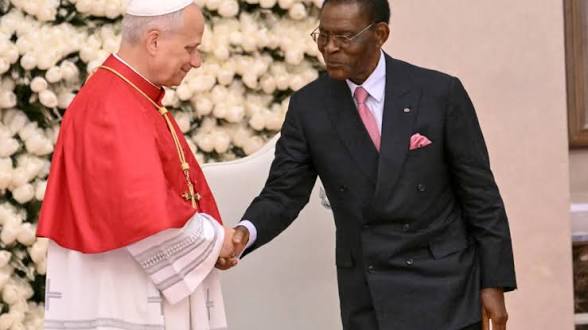
Pope Leo XIV has called on Equatorial Guinea’s leaders to place the country “in the service of law and justice,” using a rare papal visit to one of Africa’s most tightly controlled states to press for reform and greater accountability.
Addressing officials and diplomats in the capital Malabo, the pontiff urged the government to rethink its development model, arguing that true progress depends on institutions that protect rights, curb corruption and share the nation’s wealth more fairly. He framed respect for the rule of law as a path for Equatorial Guinea to strengthen its standing on the international stage.
The pope warned that unchecked inequality is eroding social cohesion, pointing to a widening gulf between a powerful elite and the majority of citizens. Modern injustice, he said, is increasingly visible in those who are excluded from basic services, dignified work and political participation.
Equatorial Guinea, one of sub-Saharan Africa’s largest oil producers, has long been criticized for failing to translate its hydrocarbon riches into broad-based development. While gleaming buildings and luxury projects dominate parts of Malabo and Bata, rights groups report that many communities still lack reliable electricity, clean water and adequate healthcare.
President Teodoro Obiang Nguema Mbasogo, who has ruled the country for decades, received Pope Leo XIV at the presidential palace, accompanied by senior officials including Vice President Teodoro Nguema Obiang Mangue. State media hailed the visit as a sign of international recognition, even as advocacy organizations renewed calls for political opening and judicial independence.
The trip underscores a delicate balancing act for the Vatican. The Catholic Church is deeply rooted in Equatorial Guinea, a legacy of Spanish colonial rule, and the pope’s presence offers comfort to a largely Catholic population. Yet the Holy See is also under pressure not to appear to endorse a government frequently accused of human rights abuses, including restrictions on opposition parties, civil society and the press.
Along Malabo’s streets, thousands turned out to glimpse the papal motorcade, some waving flags and others holding handwritten signs calling for peace, jobs and justice. Residents spoke of hope that the visit might prompt change, tempered by skepticism over whether the country’s entrenched power structures will heed the pope’s appeal.
Equatorial Guinea is the final stop on Pope Leo XIV’s multi-nation African tour. He is expected to travel to Mongomo and Bata, where he will celebrate Mass and meet clergy and lay leaders, urging them to be “guardians of the poor” and to keep pressing, peacefully but persistently, for a more just society.