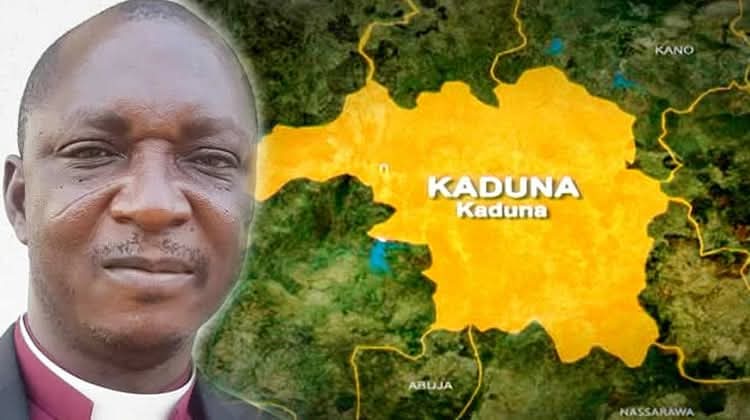
The Christian Association of Nigeria in the 19 Northern states and the Federal Capital Territory has demanded urgent and transparent action from security agencies following the abduction of worshippers from churches in Kajuru Local Government Area of Kaduna State.
Its chairman, Reverend Joseph Hayab, condemned what he described as an “unfortunate and damaging” initial denial by security authorities, warning that such responses erode public trust and deepen the sense of vulnerability among citizens already living under the shadow of violence.
Hayab, who spoke in a televised interview, said that after direct engagement with senior security officials, there was no longer any doubt that armed men invaded churches in the Kurmin Wali axis of Kajuru and took worshippers into the bush.
“This unfortunate incident happened. Innocent Nigerians were taken away from their church. There is no longer debate about it,” he said, adding that security agencies had privately confirmed the attack to Christian leaders even before acknowledging it in public.
“If they have not acknowledged it publicly, they have acknowledged it to us as Christian leaders. They have given us a promise that they will go after them,” he stated.
The abduction was initially shrouded in confusion. Local sources in Kajuru reported that gunmen attacked multiple churches and abducted dozens of worshippers during Sunday services. However, early official reactions appeared to contradict these accounts. The Kaduna State Police Commissioner, Muhammad Rabiu, was quoted as saying that security operatives deployed to the area initially found no evidence of an attack.
That denial, Hayab said, was both painful and dangerous. According to him, community members and church leaders had raised the alarm almost immediately after the incident, and security agencies were informed in real time.
“The moment the incident happened, security agencies were informed. That is why we were worried and angry, how could they later come out to deny it? That denial was the most unfortunate statement,” he said.
He expressed sympathy for Kaduna State Governor Uba Sani, arguing that inaccurate or delayed field reports from security formations risk misleading political leaders and undermining their efforts to address insecurity.
“I sympathise with Governor Uba Sani, who is working hard, only to receive wrong information,” Hayab said.
As conflicting narratives spread, operational and intelligence units at the national level later confirmed that an abduction had indeed taken place in Kurmin Wali, Kajuru. This triggered the deployment of tactical teams and the launch of coordinated search-and-rescue operations in the area and surrounding communities.
The Inspector-General of Police, Kayode Egbetokun, ordered the full mobilisation of operational and intelligence assets to Kajuru, with a mandate to track the attackers, rescue the abducted worshippers and stabilise the area.
Hayab said CAN’s own grassroots communication network had been crucial in piecing together what happened. The association, he explained, maintains structures from the national level down to regions, states, local governments and wards, enabling it to receive rapid alerts from remote communities.
“The Christian Association of Nigeria is highly connected. We operate from the national level to the region, the states, the local governments and down to the ward level. Our system of communication is such that we do not have difficulty knowing when, where and how things happen,” he said.
He disclosed that he received the first alert at 2:56 p.m. on Sunday, even though the Kaduna State CAN chairman was out of the country at the time. The initial message reported that an unverified number of worshippers had been taken from churches in Cherebun and Serebun I and II, also known locally as Bishara, Haske and a nearby ECWA congregation.
“They later sent another message to say that gunmen shut the entire church, lined the worshippers up and marched them into the bush,” he recounted.
According to Hayab, fear and chaos in the affected communities made it difficult to immediately determine how many people had been abducted. Some residents fled, others hid, and a number of abductees later escaped and returned, further complicating efforts to compile accurate figures.
“Because of fear at the time, nobody could immediately verify who and how many were taken. That was why we were careful with numbers,” he explained.
As news of the attack filtered out, media reports began to circulate, with some outlets quoting figures as high as 163 abducted worshippers. Social media posts by local pastors and residents amplified the story, prompting a wave of inquiries to CAN from within and outside Nigeria.
Hayab insisted that the association did not seek to sensationalise the tragedy. Instead, he said, CAN deliberately avoided endorsing specific figures until it could verify them, focusing instead on the core fact that a large number of worshippers had been taken from their place of worship.
“A lot of people were kidnapped, that is the truth. Some escaped and returned, which affected the numbers. What we told the government is: let us not debate too much about numbers. Let us focus on the fact that people were taken in good numbers,” he said.
He added that the public denial by security agencies, coming after families had already confirmed that their relatives were missing, turned the incident into a test of credibility for both the authorities and religious leaders.
“When the story went public, we were boxed in. Everybody was asking us questions. This became a test of integrity and honesty. Imagine the families of those kidnapped hearing someone say it never happened,” he said.
Hayab urged security agencies to prioritise empathy, transparency and prompt communication in handling such sensitive incidents. A simple acknowledgment of the attack and a clear commitment to pursue the perpetrators, he argued, would have reassured citizens and strengthened confidence in the state.
“A good number of people were taken. What we are simply calling for is: get our people back. If security agencies had simply acknowledged it and said, ‘We will go after them,’ Nigerians would have applauded. Nigerians just want assurance and action,” he said.
He described the attackers as terrorists, aligning himself with the federal government’s position that any armed group taking up weapons against the Nigerian state and its citizens should be treated as a terrorist organisation.
“Terrorists are out to torment this country and create confusion. Differentiating bandits from terrorists sometimes confuses Nigerians. The President himself has said that any group that takes arms against Nigeria is a terrorist group. So I align with my President and call those who took worshippers from church terrorists,” he said.