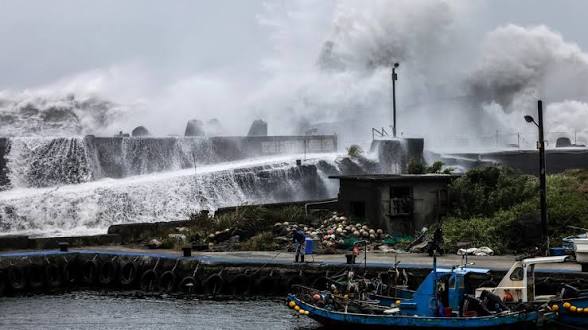
More than 900,000 people have been forced from their homes in eastern China as Typhoon Bavi drives powerful winds and torrential rain across a swathe of East Asia, lashing northern Taiwan and Japan’s remote southwestern islands and triggering mass evacuations, power cuts and travel chaos.
Chinese authorities in the coastal city of Wenzhou, in Zhejiang province, ordered 887,801 residents to move to safer ground as the storm barrelled toward the mainland. Officials described a “proactive, all-out mobilisation” aimed at preparing for a worst-case scenario, with emergency shelters opened, fishing fleets recalled to port and hillside communities warned of landslide risks.
Residents in low-lying districts reinforced metal shutters with wooden planks and taped up windows as state television warned of “exceptionally heavy rains” for eastern Zhejiang and neighbouring Fujian. Further north, more than 100,000 people were evacuated as authorities increased discharge from the Miyun Reservoir near the capital to create capacity for incoming floodwaters.
In northern Taiwan, streets were largely deserted as wind and rain pounded coastal cities. Most businesses remained shut and more than 14,000 people were evacuated from vulnerable areas. Hundreds of flights were cancelled and over 170,000 households lost electricity as falling branches and debris damaged power lines.
Some residents still ventured out to work. A breakfast shop owner in the port city of Keelung said she opened to feed people on duty despite the conditions, while others complained that official warnings had emptied shops and cut income on what felt, to them, “just like a rainy day.”
Bavi, once a super typhoon over the Pacific, weakened as it approached Taiwan but still packed sustained winds of about 137 kilometres per hour, with gusts up to 173 kilometres per hour, according to Taiwan’s Central Weather Administration. Forecasters warned of “extremely torrential rain” in the island’s north and waves up to 10 metres high along exposed coasts.
The storm’s reach has been deadly elsewhere. In the Philippines, at least 18 people have died in landslides and flood-related incidents linked to Bavi’s rains, with nearly 11,000 residents displaced and dozens of ports closed. Across Japan’s Okinawa prefecture, more than 18,000 households lost power as the Miyako region took the brunt of the winds, and airlines cancelled dozens of flights, disrupting travel for more than 26,000 passengers.
Scientists say unusually warm ocean waters are helping tropical systems like Bavi intensify and carry more moisture, amplifying the risk of destructive rainfall and flooding across the region.






.jpeg?alt=media&token=96b327a5-8e62-4ed1-a078-308aff149ed1)

