Keir Starmer has announced he will step down as prime minister and leader of the Labour Party, bringing an abrupt end to a premiership that began with a landslide election victory but quickly descended into turmoil.
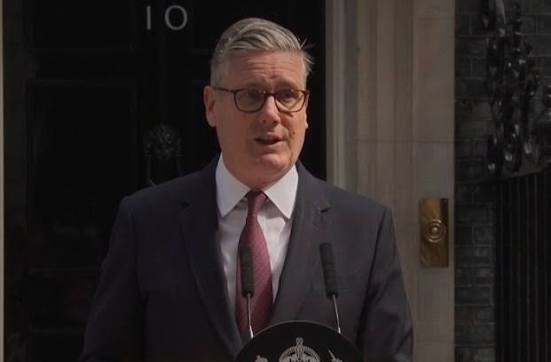
Speaking outside 10 Downing Street, Starmer delivered an emotional statement in which his voice cracked as he framed his decision as an act of duty rather than defeat. “Every decision I have taken has been about putting the country I love first. That is why I will resign as leader of the Labour Party,” he said, flanked by his family and senior aides.
Starmer confirmed that the Labour leadership contest will begin in July. He will remain in office as caretaker prime minister until a successor is chosen, with the new leader expected to be in place before Parliament returns from its summer recess. “I will remain in post as prime minister until the contest is complete, and I will do everything I can to ensure an orderly handover of power,” he pledged.
The announcement caps a bruising period for Starmer, whose authority had been eroded by a series of policy reversals, internal rebellions and sliding poll ratings. Once hailed for transforming Labour into an election-winning force after years in opposition, he became increasingly associated with indecision and misjudgment.
His government was rocked by public anger over benefits cuts and fierce criticism of defence spending plans that many in his own party branded incoherent. The most damaging episode came with his decision to nominate Peter Mandelson as UK ambassador to Washington, despite Mandelson’s links to the disgraced US financier Jeffrey Epstein. The appointment triggered a near-revolt in Labour ranks and a failed attempt to unseat him in March.
Pressure intensified as the right-wing Reform UK party surged in support, capitalising on discontent over immigration and the cost of living. Its breakthrough in local elections, where it snatched key Labour strongholds, was widely seen as a turning point that shattered Starmer’s claim to be the only credible vehicle for change.
Attention now turns to Starmer’s likely successor. Andy Burnham, the veteran Labour figure and former mayor returning to Parliament after a by-election victory, is viewed as the early frontrunner to lead the party and the country.
Starmer ended his statement with a final defence of his record. “I will also give my successor my full and unequivocal support, knowing that they will inherit a Britain that is far stronger and fairer than the one I inherited two years ago,” he said, before turning back through the black door of Number 10.