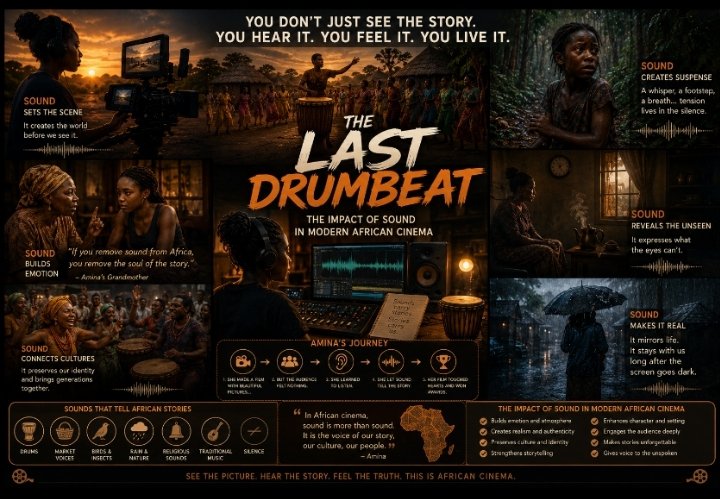
THE LAST DRUMBEAT
The village of Ogbara was famous for one thing—the sound of its drums.
Before the first rooster crowed, the talking drum would wake farmers. At noon, children knew it was time to return home because of the wooden flute echoing across the hills. During festivals, every heartbeat of the village synchronized with the rhythm of drums, rattles, songs, and laughter.
Among the villagers lived a young filmmaker named Amina.
Unlike everyone else, Amina did not only hear sounds; she saw stories inside them.
Her grandmother always told her,
"If you remove sound from Africa, you remove the soul of the story."
Amina laughed whenever she heard those words. She believed beautiful camera shots alone could tell any story.
After graduating from film school, she returned home determined to produce a movie that would win international awards.
She invested all her savings in hiring expensive cameras, drones, sounds lights, costumes, and actors.
When the movie was completed, everyone admired the visuals.
The sunset looked magical.
The costumes were breathtaking.
The locations were perfect.
Yet...
When people watched it, nobody cried.
Nobody laughed.
Nobody felt afraid.
Nobody remembered the story after leaving the cinema.
The audience applauded politely, but inside, the film was empty.
Confused, Amina visited her grandmother.
The old woman simply smiled and asked,
"When your father died, what did you remember first? His face... or the women crying?"
Amina paused.
She remembered the painful cries.
She remembered the funeral songs.
She remembered the silence after everyone had left.
She remembered the slow beating of the village drum.
Not the pictures.
The sounds.
That night changed everything.
Months later, Amina began another film.
This time she treated sound as the main storyteller.
When a little girl got lost in the forest, there was no background music.
Instead...
The wind whispered through the trees.
Dry leaves cracked beneath frightened footsteps.
Birds suddenly stopped singing.
Heavy breathing filled the silence.
The audience felt the girl's fear before seeing her face.
In another scene, an old mother waited for her son who had gone to the city.
There were almost no words.
Only...
The ticking of an old wall clock.
The distant barking of dogs.
A kettle gently boiling.
Her quiet sigh.
The silence inside the lonely house.
Without dialogue, viewers understood loneliness.
During a wedding celebration, Amina mixed traditional African drums with modern Afrobeats.
Young viewers danced.
Older viewers smiled proudly.
The music connected generations.
In another emotional scene, she deliberately removed every sound after a tragic accident.
Complete silence.
The cinema hall became still.
Some audience members began wiping away tears.
They were not crying because someone told them to cry.
They cried because silence itself had become the loudest sound.
When the film premiered across Africa, something remarkable happened.
Critics praised its cinematography.
But what everyone remembered was the sound.
People talked about the realistic market noises.
The evening insects.
The Islamic call to prayer blending naturally with village life.
Church bells ringing on Sunday mornings.
The sound of rain falling on rusty zinc roofs.
The joyful ululation of women during celebrations.
The heartbeat-like drum rhythms during moments of tension.
The whispers of ancestors in dream sequences.
Every sound carried meaning.
The film won several awards.
An interviewer asked Amina,
"What made your second film so different?"
She smiled.
"I stopped using sound to accompany pictures."
"I allowed sound to tell the story."
Years later, film students visited Amina's studio.
Instead of showing them cameras first, she played different audio recordings.
Footsteps.
Rain.
Market noise.
Children laughing.
A crying baby.
Traditional drums.
Flowing rivers.
Silence.
Then she asked,
"What story did you imagine?"
Each student described a completely different scene.
Amina smiled again.
"You have just discovered the greatest secret of African cinema."
"Sound creates pictures inside the audience's mind before the camera ever does."