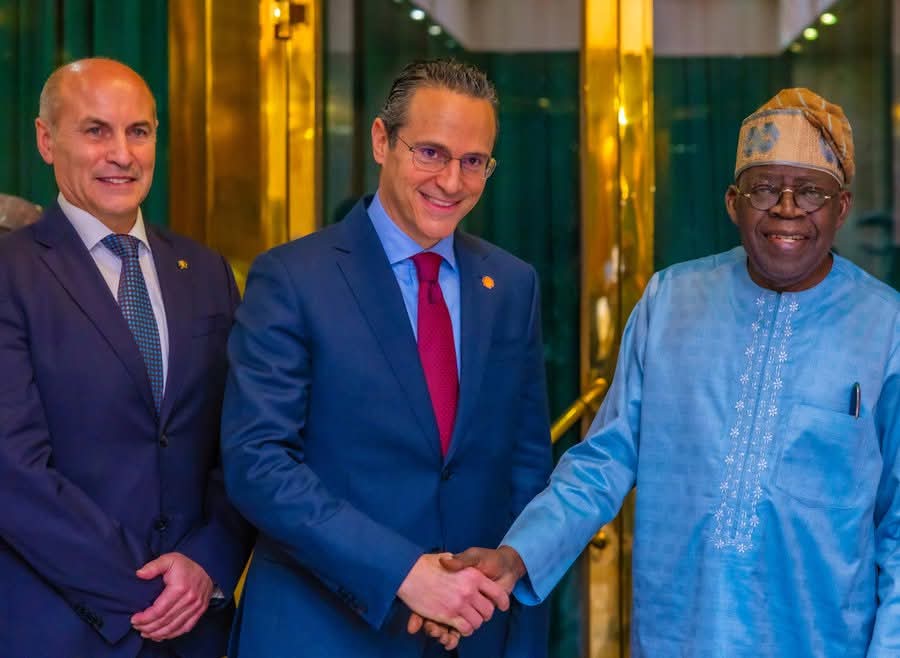
Shell Plc’s Chief Executive Officer, Wael Sawan, has enthusiastically commended Nigeria’s President Bola Tinubu for fostering a stable and attractive investment climate that has underpinned the company’s renewed commitment to the country’s energy sector.
In a high-profile meeting at the Presidential Villa in Abuja, Sawan highlighted that Shell’s decision to deepen its Nigerian footprint amid a global backdrop where many energy firms are cautious about capital deployment is largely due to the “robust and bold leadership” and policy consistency demonstrated by the Tinubu administration.
He specifically noted that investor confidence has been restored and that Nigeria is once again seen as a preferred destination for long-term energy investment.
The proposed investment, which could total $20 billion, centers on the Bonga South West deepwater project, a major offshore development that Shell describes as potentially among the world’s largest energy investments if it reaches a Final Investment Decision (FID).
Sawan explained that roughly half of the funds would be directed toward capital expenditures, with the remainder supporting operating costs and related in-country economic activity, infusing billions into Nigeria’s economy. He also cited existing commitments, including recent investments of around $5 billion in the Bonga North field and $2 billion in other upstream projects, as evidence of the company’s long-term strategic focus.
President Tinubu welcomed Shell’s renewed confidence and approved the gazetting of targeted, investment-linked incentives to support the Bonga South West development, stressing that these incentives are ring-fenced and aimed at new capital, local content, and value addition rather than blanket concessions. Tinubu set a clear expectation that the project should reach FID within his current term, underscoring the government’s commitment to timely implementation and broader economic impact.
Shell’s deepened engagement and the substantial financial pledge signal a significant vote of confidence in Nigeria’s energy policy reforms and could catalyze further foreign direct investment into the sector.