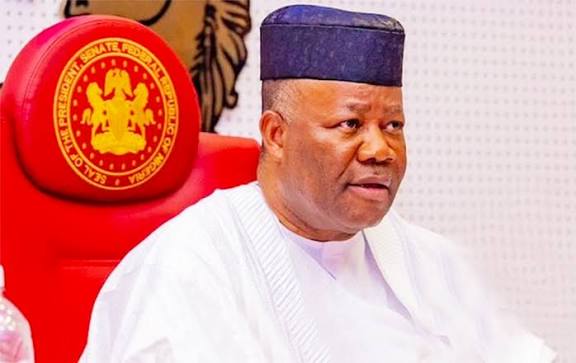
Senate President Godswill Akpabio says his decision to withdraw a raft of defamation suits, including a high-profile case against Senator Natasha Akpoti-Uduaghan, was not an act of weakness but a conscious choice anchored on faith, moral authority and the burdens of leadership.
In a detailed statement issued by his Special Adviser on Media and Publicity, Eseme Eyiboh, Akpabio framed the move as a break with a political culture in which litigation has become a routine weapon for reputation management and political combat.
For years, Akpabio had been known to defend his name vigorously in court, often turning to defamation suits to challenge allegations he considered false or malicious. According to him, the law had served both as a shield to protect his image and a sword to push back against critics.
“In a political culture where litigation has become an extension of reputation management, this was no minor gesture. The law, in his hands, had been both shield and sword. To voluntarily lay it down is to interrupt a habit of power,” Eyiboh quoted the Senate President as saying.
Akpabio argued that the real question was not whether he could afford to forgive those he believed had maligned him, but why he chose to do so at this particular moment. He presented the answer as a blend of personal conviction and institutional responsibility.
“Managing a Senate of 109 senators requires restraint, credibility and example,” the statement noted. “The Senate has been unusually productive and notably calm—more than ninety-six bills passed in two years, with over fifty-eight assented to by the President. In a chamber once notorious for theatrics, this stability is not accidental. It reflects a leadership style that values restraint over spectacle and consensus over conquest.”
Akpabio urged observers to see the withdrawal of his lawsuits not merely as a private act of forgiveness but as a public lesson in how political disagreements should be handled. He described forgiveness, in this context, as a form of “civic pedagogy” aimed at lowering the political temperature and modelling a less adversarial style of politics.
The Senate President’s decision had first come to light when he publicly announced, during a New Year church service, that he would discontinue all defamation cases he had instituted. He said the turning point came during a Mass at Sacred Heart Parish in Uyo, Akwa Ibom State, where a homily on forgiveness struck him as a direct personal challenge.
Addressing the congregation, Akpabio disclosed that he had nearly nine defamation suits pending against various individuals over statements he believed had damaged his reputation. He recounted how, listening to the priest, he felt compelled to reassess his stance.
“I had almost nine cases in court against some individuals who defamed me, who lied against me, who slandered my name,” he said. “But I listened to the priest and suddenly realised he was talking to me, so I hereby direct my solicitor to withdraw all lawsuits against them.”
Among the most prominent of those cases was a ₦200 billion defamation suit he filed against Senator Akpoti-Uduaghan. The case stemmed from allegations of sexual harassment which she had publicly levelled against him and which he vehemently denied, insisting she should prove them in court.
The legal confrontation between both senators had unfolded against a backdrop of rising tension in the upper chamber. Their relationship deteriorated sharply after Akpoti-Uduaghan accused Akpabio of orchestrating or influencing her suspension from the Senate following her public allegations of misconduct. She, in turn, approached the courts to challenge actions taken against her and filed a ₦100 billion defamation suit against Akpabio and others, claiming that remarks attributed to them had gravely harmed her reputation.
Akpabio’s wife also entered the legal fray, instituting separate defamation actions against the Kogi Central senator over statements she said had tarnished the family’s name. The flurry of suits on both sides transformed a political disagreement into a sprawling legal battle that drew intense media scrutiny and deepened divisions within the legislature.
By directing his lawyers to withdraw all the cases he had personally instituted, Akpabio effectively pulled the plug on his side of the courtroom hostilities. His camp has framed the move as a gesture of magnanimity and a signal that he prefers to focus on governance rather than personal vendettas.
Eyiboh’s statement underscored that point, stressing that the Senate President’s choice was informed by a broader understanding of what the moment demanded from the head of the legislature. In a period marked by economic strain, public discontent and political friction, Akpabio suggested that Nigerians expected their leaders to demonstrate maturity, restraint and a willingness to rise above personal grievances.
He argued that forgiveness, in this sense, was not a retreat but a strategic tool for maintaining cohesion in the Senate and ensuring that legislative energy remained directed at national priorities rather than personal feuds.
“This is where forgiveness ceases to be sentimental and becomes political philosophy,” the statement said. “The same drive for tangible outcomes has characterised, albeit differently, his tenure as Senate President.”