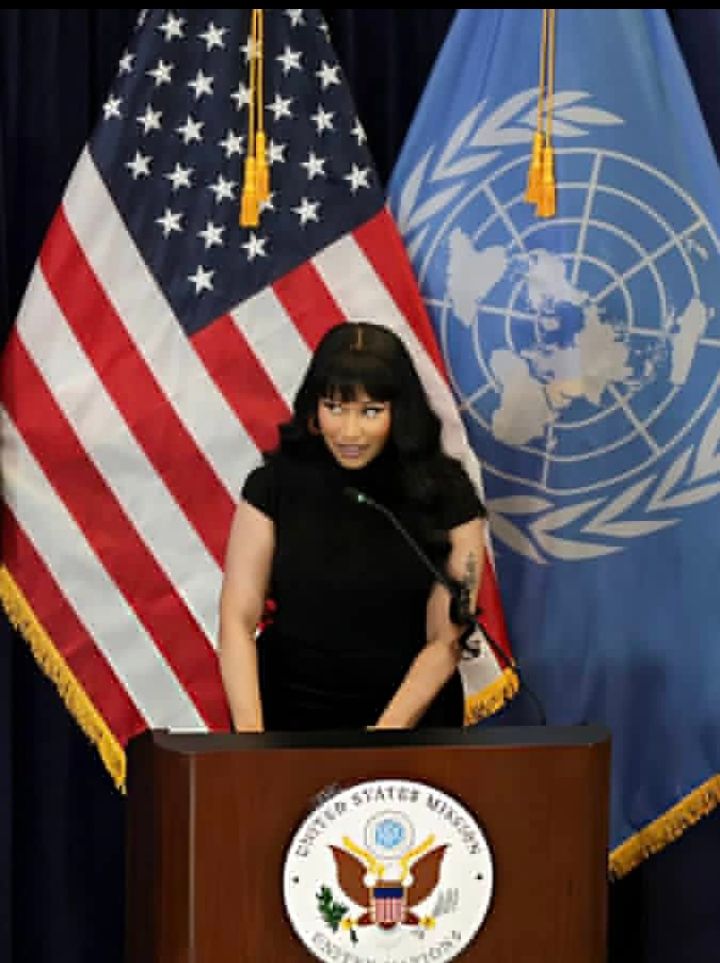
Nicki Minaj’s recent decision to lend her voice to Nigeria’s ongoing crisis has sparked global conversation not only because she is one of the world’s most influential pop culture figures but also because her intervention came from an unexpected but powerful place. In a world where celebrities often shy away from political and humanitarian issues outside their borders, Nicki Minaj stepped into the international stage, specifically the United Nations, to speak passionately about the violence, fear and persecution she believes Nigerians are facing especially within Christian communities. Her speech echoed a sentiment of urgency, painting a picture of families displaced from their homes, churches burned and communities living in fear because of their faith.
In her message, she emphasised that her involvement was not about politics but about humanity. She stressed that standing up for people whose lives are threatened because of their religious identity is a universal responsibility. She argued that every individual, regardless of culture, language or belief system should feel safe enough to practice their faith without fear. For her, freedom of belief is deeply tied to the universal language of music, a force that she says unites people across cultures and brings life to the soul. She connected this idea to Nigeria, a nation she described as beautiful and rich in spiritual traditions, filled with people who have inspired her through their creativity, culture and resilience.
Part of the reason her speech gained so much attention was her acknowledgment of world leaders including her public appreciation for Donald Trump’s efforts in bringing religious violence in Nigeria into global focus. While this earned her both applause and criticism, it demonstrated her determination to amplify any voice or policy she believes could help ease the suffering of people. Nicki Minaj insisted that she has always stood for religious freedom and would continue to do so for the rest of her life. She praised the Nigerian pastors, imams, community leaders and peacebuilders who risk their lives daily to protect innocence and confront extremism, people she described as heroes who refuse to look away.
However, Nicki Minaj’s intervention has come with controversy. While many have thanked her for using her global influence to spotlight a crisis that often receives inadequate international attention, others argue that her framing oversimplifies Nigeria’s complexities. Critics say focusing solely on Christian persecution neglects the broader picture of insecurity affecting both Christians and Muslims. Some public commentators claim her speech contained inaccuracies and fear that the issue may be politicised especially considering her alignment with certain US political figures. These criticisms reflect a deeper debate about who gets to tell Nigeria’s story and how external voices should engage with the country’s internal challenges.
Despite mixed reactions, Nicki Minaj’s involvement undeniably broadened the conversation. By stepping into a conflict far beyond the entertainment world, she highlighted the power celebrities hold in drawing global attention to humanitarian issues. Her words, amplified by millions of followers and major media outlets, have reopened discussions on religious freedom, violence and accountability in Nigeria. They have reignited global awareness and empathy for affected communities, something activists have long called for.
Nicki Minaj may not be Nigerian but her voice that is loud, unfiltered and influential has become part of a larger push for visibility, justice and compassion. Whether people agree with her approach or not, her speech has forced the world to look again at Nigeria’s pain, its resilience and the urgent need for lasting peace and stability.