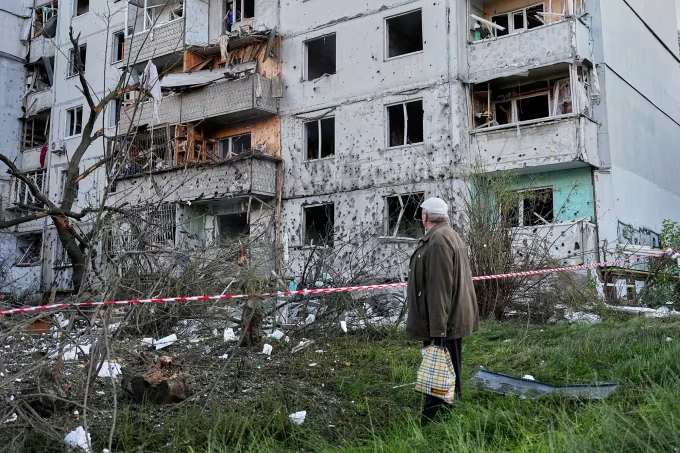
LRussia’s air attacks have grown in sheer volume in recent months, hammering Ukraine with more drones and high-speed missiles than ever before, as Moscow’s forces struggle to make meaningful progress on the ground.
The massive strikes are designed to overwhelm Ukrainian air defenses, with huge waves of cheap drones, then fast-moving ballistic missiles, then cruise missiles, coming in carefully planned succession to inflict maximum damage. Experts say that “overwhelm” approach allows more missiles to make it through.
The latest assault on Tuesday also included eight high-speed “Zircon” missiles – almost impossible to shoot down and powerful enough to take out aircraft carriers – the most ever used in a single attack, according to Ukrainian authorities. None of those eight hypersonic missiles were intercepted.
The barrage left 23 people dead and 151 injured across the country, Ukrainian authorities said. Beyond their immediate impact, experts say such attacks are part of a broader Russian strategy to sow fear among ordinary people and increase public pressure on Ukraine’s leaders to end the war.
A key factor in the increasing frequency and size of the air attacks is that “Russia is now really struggling to take any meaningful gains on the battlefield,” said Thomas Withington, an associate fellow for military sciences at UK-based think tank the Royal United Services Institute (RUSI). In April, Ukraine actually took back more land than Russia seized for the first time since 2024.
“What that means is that if you’re Russia… your mechanism for applying military pressure on Ukraine is diminished,” Withington told CNN. “I think that given this situation on the ground, the use of air power is possibly the only avenue actually now open to the Russian leadership in terms of hoping to have any kind of strategic effect on Ukraine.”
Earlier this year, Russia was launching roughly 5,000 Shahed attack drones each month. That increased to more than 8,000 last month, according to an analysis by the Center for Strategic and International Studies (CSIS), a think tank based in Washington, DC.
Although some of these drones get through, resulting in civilian casualties and damage to homes and infrastructure, analysts at RUSI and CSIS say that Ukraine’s air defenses are doing remarkably well considering the sheer size of Russia’s attacks. Ukraine has retained roughly the same interception rates for drones as before the recent escalation, downing around 90% of them each month and using electronic warfare to divert some munitions away from populated areas.