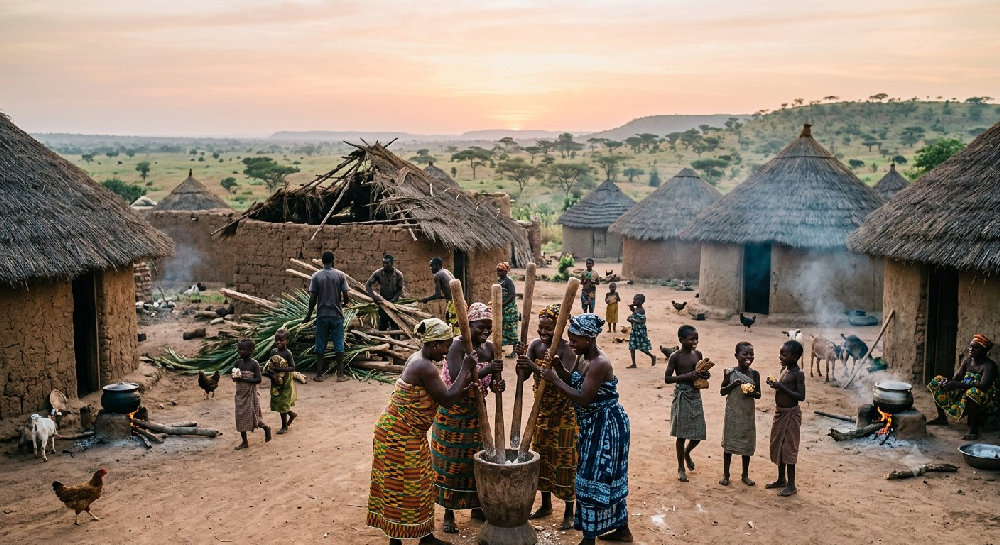
In the heart of Olumida, morning arrived not with an alarm, but with the synchronized, rhythmic thud of wooden pestles against mortars. Before the sunrise fully broke, women gathered in the central courtyard to pound cassava and maize. They swapped stories, sang traditional songs, and shared the early morning chill. In this village, daily existence was not a private affair, but a rich tapestry woven by many hands.When Papa Kwesi’s thatched roof caved in after a heavy rain, no single family bore the burden alone. By mid-morning, the call for Harambee—pulling together—echoed across the compound. The young men ventured into the nearby bush to cut fresh timber and palm fronds, while the elders guided the frame's construction with decades of practice. Meanwhile, children darted freely between houses, sitting down to eat wherever a cooking pot was boiling. In Olumida, every mother was a parent to all, every elder a revered teacher, and every hearth belonged to the entire community.Living among them transformed my entire understanding of human connection. Coming from a world obsessed with individual achievement, I quickly realized that strict independence here was viewed as an unnecessary isolation. Individual wealth mattered far less than the strength and resilience of our collective ties.In Olumida, the philosophy of Ubuntu—"I am because we are"—was not a high-minded, abstract concept taught in textbooks; it was the steady, living rhythm of daily survival. By sharing our manual labor, our evening meals, our celebrations, and our deepest griefs, no single burden was ever too heavy for one shoulder to bear. We moved together as one body, proving that a life bound to others is a life far richer and far more resilient.
1