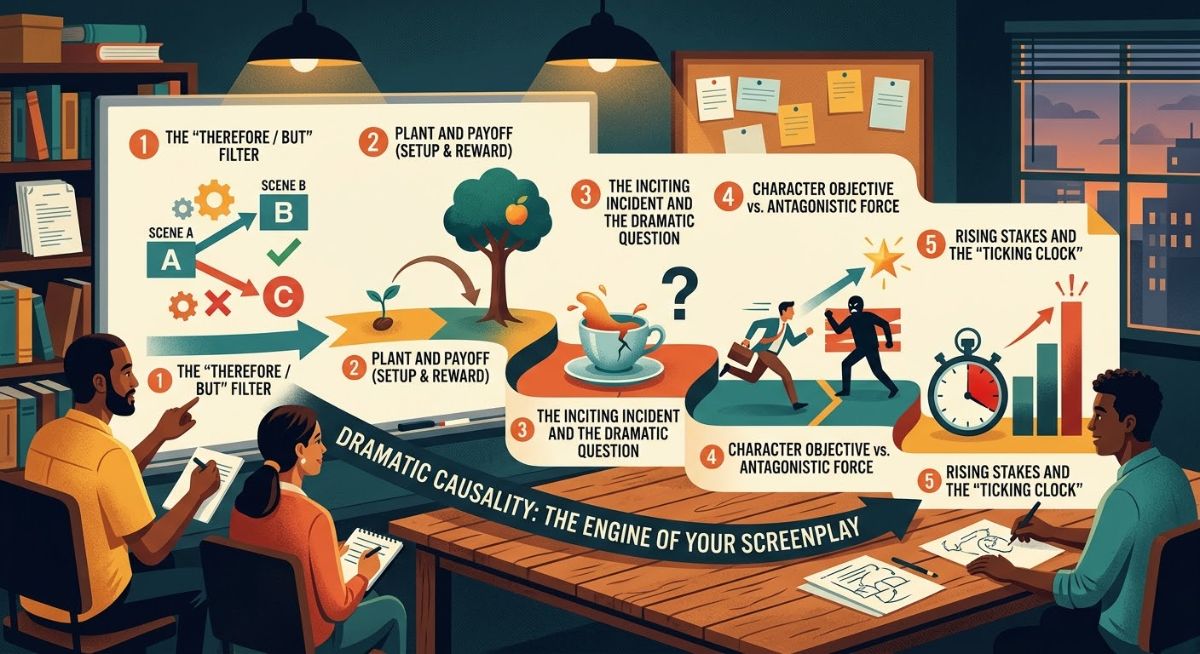
Dramatic causality is the engine of screenplay. It is the strict "therefore / but" relationship between scenes that replaces a loose, episodic "and then" structure. If Scene A doesn't directly cause Scene B, your plot will stall.
Five critical tools that can help you build and maintain the causal chain:
1. The "Therefore / But" Filter
Popularized by the creators of *South Park*, Matt Stone and Trey Parker, this tool is a simple lens to run your outline through.
If you look at your scene steps and can say, "This happens, "and then" that happens, "and then"this happens,"you have an episodic structure with zero causality. Instead, your scenes should connect like this:
Therefore:Action leads to an inevitable reaction or consequence.
But:A new complication arises, forcing a pivot.
>?Example: A detective finds a hidden flash drive (therefore) he decrypts it at home, (but) the villain’s mercenaries are tracking the drive's IP address, (therefore) they raid his house…
2. Plant and Payoff (Setup and Reward)
A plant is a piece of information—an object, a line of dialogue, a character trait—introduced early in the script that seems minor or ordinary. The payoff is when that element returns later with massive narrative weight.
For a plant and payoff to create causality, the payoff cannot feel like a random coincidence. The audience must look back and realize the final outcome was actively set in motion by the early plant. It rewards the audience for paying attention and makes the climax feel earned.
3. The Inciting Incident and the Dramatic Question
The inciting incident is the disruption that breaks your protagonist's status quo. It acts as the primary domino that tips over all the others. This event births the *Central Dramatic Question*(e.g., *Will Brody kill the shark? Will Cobb get back to his kids?*).
Every subsequent scene in your screenplay must serve as an attempt to answer that question. A scene has dramatic causality if it either pushes the protagonist closer to answering that question or throws up a massive roadblock. If a scene doesn't impact the central question, it doesn't belong in the chain.
4. Character Objective vs. Antagonistic Force
Causality is born from conflict, not just random events. You need a tight collision between two opposing forces:
The Protagonist's Objective: What they want in the scene/sequence.
The Antagonistic Force: The person, environment, or internal flaw blocking that goal.
When your character acts to achieve their goal, they hit a wall. Their reaction to hitting that wall dictates their next move. This creates an organic, character-driven causal loop: “Action \rightarrow Obstacle \rightarrow Complication \rightarrow New Action”.
5. Rising Stakes and the “Ticking Clock”
To keep the momentum of your causality progressing rather than spinning its wheels, the consequences of failure must escalate with every act. A ticking clock introduces a literal or thematic deadline.
When you tighten the clock or raise the stakes, you limit the protagonist's options. They can no longer take the safe, easy route. This forces them into desperate, high-risk choices that cause massive, unpredictable fallout—perfectly fueling the next sequence of scenes.
Tool ,Core Function, Screenplay Impact
"Therefore / But" Eliminates episodic "and then" writing | Tightens scene-to-scene pacing |
Plant & Payoff", Links early setups to late-stage resolutions ,Makes the climax feel inevitable, not accidental .
"Inciting Incident", Establishes the Central Dramatic Question, Gives the entire plot a clear, singular direction
Objective vs. Friction, Pits character goals against active obstacles | Drives character-centric plot progression |
Ticking Clock / Stakes", Escalates the cost of failure over time | Forces characters into high-consequence actions.