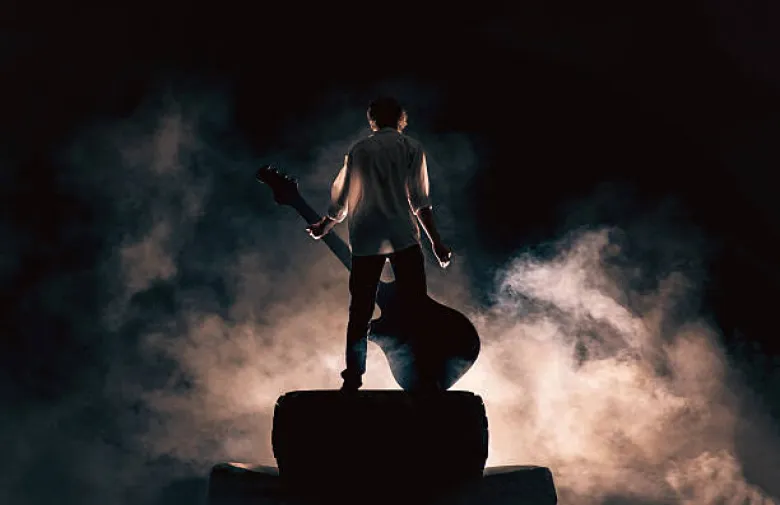
Liam had always found solace in music. As a child, he would sit by the window, his fingers tapping out silent rhythms on the wooden sill while his mother hummed in the kitchen. The world outside moved too fast, too unpredictably, but music—music was steady, reliable. It was his safe place.
That safe place shattered the day his father left.
It happened quietly, without drama or raised voices. Just a note on the kitchen table and a silence that swallowed the house whole. Liam was ten. He didn't fully understand why his mother stopped singing after that, why her laughter disappeared into long nights spent staring at unpaid bills.
The weight of survival fell on her shoulders, and Liam, feeling helpless, buried himself in melodies. He taught himself guitar with a battered instrument from a pawn shop, playing until his fingertips bled. In those strings, he found a language for his grief.
But the world wasn’t kind to dreamers.
"You think music will feed you?" his uncle scoffed one evening, watching him strum away. "Get serious, Liam. The real world doesn’t care about your songs."
His mother, exhausted from double shifts, sighed but said nothing. That silence hurt worse than his uncle’s words.
By the time he reached college, Liam knew better than to expect support. He worked odd jobs to afford his education while sneaking into music clubs at night, performing for small crowds that barely noticed him. He was a whisper in a world full of noise.
Then came the accident.
A careless driver. A shattered windshield. A hospital waiting room where time stretched unbearably. His mother never made it out of surgery.
Grief became his shadow. The weight of it was unbearable, suffocating. The thought of picking up his guitar made his hands tremble. Music had always been his refuge, but now, it felt hollow.
For months, he disappeared into silence. Bills piled up. His mother’s absence turned their home into an echo of what it once was. And then, one day, he found her old notebook—pages filled with unfinished lyrics, words she had scribbled long before life had worn her down.
"Sing for yourself, my love. Even when the world won’t listen."
Tears blurred the ink, but something stirred within him.
Liam picked up his guitar again. At first, his fingers felt stiff, clumsy. But as he played, something inside him cracked open. The sorrow, the loneliness, the memories—he poured them into a song. It wasn’t perfect, but it was real.
He recorded it in his tiny apartment and uploaded it online, expecting nothing. But the world had a way of listening when you least expected it.
One share turned into ten, then a hundred. His song became an anthem for those who had lost, those who had struggled, those who had felt invisible. People reached out, telling him how his music gave words to their pain.
And for the first time in years, Liam felt seen.
Music, the very thing he had once feared was useless, became his purpose. It carried him through his darkest nights and led him to the light. Today, as he stands on a stage, looking out at a sea of faces singing his lyrics back to him, he knows—his mother was right.
Even when the world won’t listen, you keep singing. Because one day, someone will hear you. And in that moment, you’ll realize that your voice was never meant to be silenced.