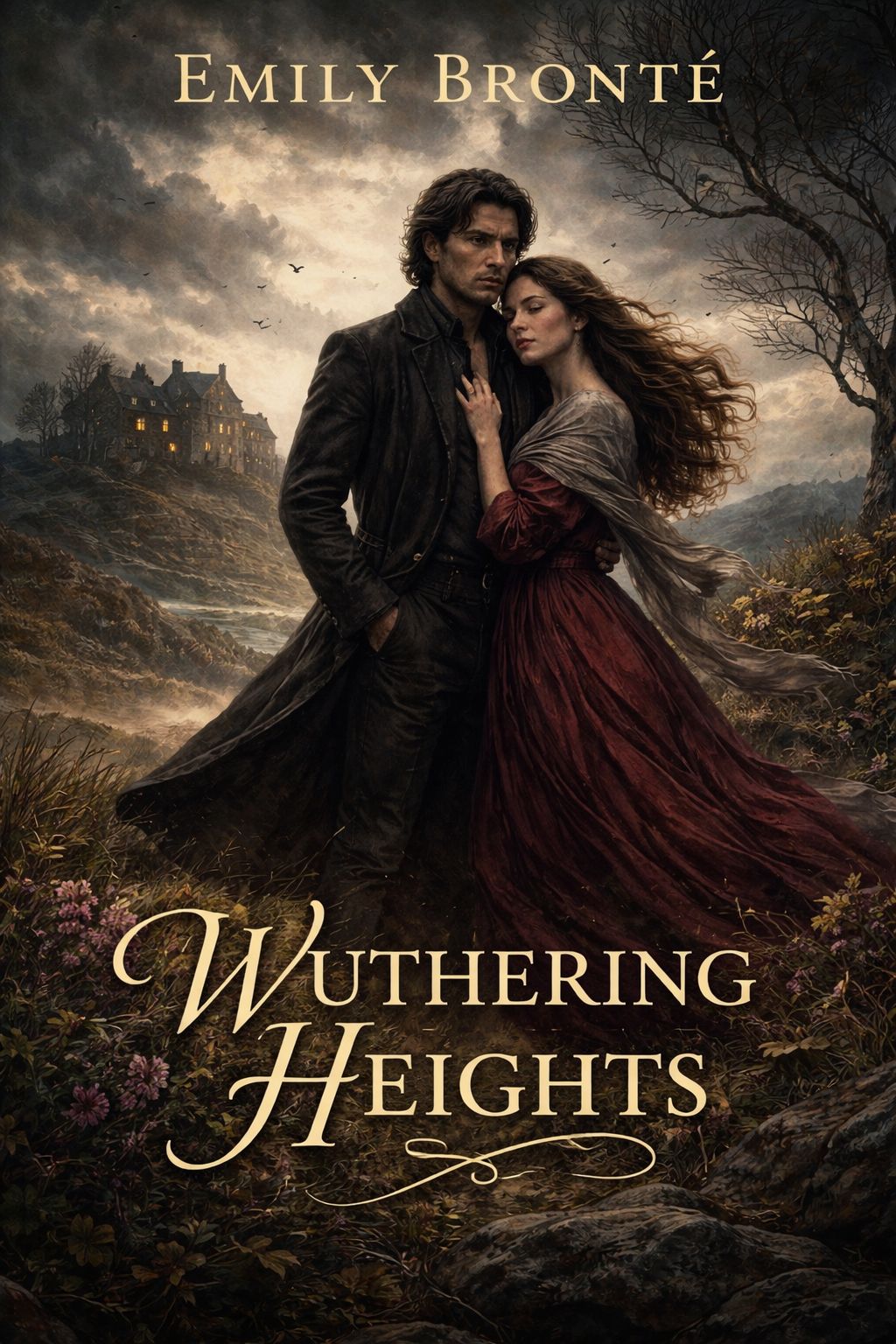
Book Title: Wuthering Height
Author: Emily Brontë
Pages/Size: Approximately 300–350 pages
Price/Value: Low-cost / affordable / often free online
Wuthering Heights was first published in 1847 by Thomas Cautley Newby. The novel appeared under the pseudonym “Ellis Bell,” reflecting the restrictive literary environment faced by female writers in the Victorian era.
The novel addresses themes such as obsessive love, revenge, social class conflict, pride, and the consequences of emotional excess. It presents love not as an idealized emotion but as a powerful and sometimes destructive force that shapes human behavior across generations.
The central characters are Heathcliff and Catherine Earnshaw. Heathcliff is depicted as a complex and vengeful figure whose actions are shaped by neglect and humiliation, while Catherine represents inner conflict between passion and social ambition. Supporting characters such as Edgar Linton and Nelly Dean serve as moral and narrative contrasts.
Critical Evaluation
Critically, Wuthering Heights is remarkable for its originality and resistance to conventional Victorian storytelling. Emily Brontë rejects the moral simplicity common in nineteenth-century novels and instead presents characters who are deeply flawed, emotionally driven, and morally ambiguous. This complexity allows the novel to offer a realistic portrayal of human nature, where actions are shaped by trauma, desire, and social constraint rather than clear ethical ideals.
The narrative structure of the novel further strengthens its critical value. The use of multiple narrators—primarily Lockwood and Nelly Dean—creates a layered storytelling technique that distances readers from events and encourages interpretation rather than passive acceptance. While this structure may initially confuse readers, it effectively highlights issues of bias, memory, and unreliable narration, making the novel intellectually engaging.
In addition, the setting of the Yorkshire moors plays a symbolic role in reinforcing the novel’s emotional intensity. The harsh and untamed landscape mirrors the violent passions and emotional isolation of the characters. Brontë’s language and imagery contribute to a gloomy atmosphere that supports the novel’s themes of suffering and endurance.
However, the novel’s dark tone, frequent cruelty, and absence of clear moral justice have been criticized by some readers. Despite this, these elements are deliberate and essential to its artistic purpose. Rather than offering moral comfort, Wuthering Heights confronts readers with the consequences of unchecked emotion and social exclusion. For these reasons, the novel stands as a bold, psychologically rich, and enduring work of literature.
In conclusion, I will say Wuthering Heights remains a powerful and influential novel due to its emotional depth, complex characterization, and innovative narrative style. Its continued relevance lies in its honest exploration of human passion and moral ambiguity, making it a significant text for critical study and review writing.