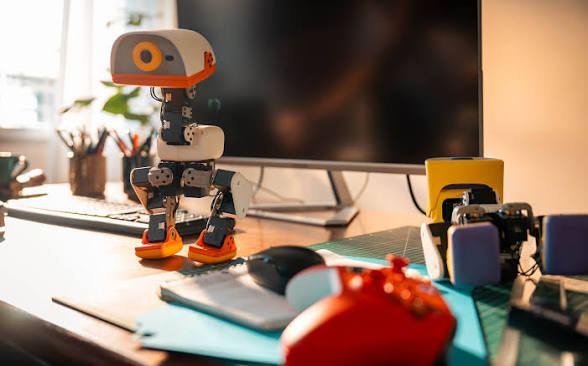
Hugging Face, the AI company best known for hosting open-source language models, is moving deeper into hardware with Microduck, a $399 duck-like robot designed to bring “physical AI” into homes, labs, and classrooms.
Standing about 25 centimeters tall, Microduck looks playful but is built as a serious research and education platform. The robot can waddle on its own, crouch, recover after a fall, pick up objects weighing up to 800 grams with its beak, and even roller skate. Its body is packed with sensors, including a camera, lidar, and dual inertial measurement units, giving it a detailed sense of balance, motion, and surroundings.
Hugging Face chief executive Clem Delangue describes Microduck as an open-source robot that can be taught new tricks using reinforcement learning. Instead of relying solely on preprogrammed behaviors, developers can train the robot in simulation, deploy those behaviors to the physical duck, observe how it performs, then fine-tune and retrain. Pollen Robotics, the French robotics startup Hugging Face acquired to accelerate its hardware push, says the full software development kit, simulator, and reinforcement learning stack are available for developers to inspect and modify.
Microduck follows Reachy Mini, a desktop robot platform that Pollen and Hugging Face positioned as an affordable entry point into robotics research. With Microduck, the companies are extending that philosophy to mobile robots that can navigate and manipulate the physical world, while keeping the hardware and software stack open for experimentation.
The project also highlights a growing debate over privacy in consumer robotics. Delangue has argued that robots powered by open-source models are easier to audit and therefore safer than opaque systems controlled by a handful of large companies. Still, privacy experts note that once third-party applications are installed, those apps may access cameras and microphones and transmit data elsewhere, regardless of how transparent the base model is.
Microduck’s debut lands at a pivotal moment for Hugging Face, which has been expanding its ambitions beyond model hosting into chips, infrastructure, and now embodied AI. The company’s push into open, programmable robots suggests it sees the next frontier of AI not just on screens and servers, but waddling around the real world.