The halls of Nigerian universities are hallowed grounds, steeped in the ambition of millions. But for many students navigating the current landscape, the experience often feels less like an academic journey and more like a high-stakes endurance test; both mentally and, crucially, financially.
There is a cynical, yet painfully relatable, joke whispered in lecture halls across the country: In Nigerian universities, the rate of spending is inversely proportional to the rate of learning, provided that stress is kept constant.
It’s a witty observation, but it masks a frustrating reality. If we look at this as an economic equation, we find ourselves stuck in a paradox where the cost of entry seems to far outweigh the value of the instruction.
THE ECONOMIC PARADOX OF EDUCATION
Think of your university experience as a system. If we apply the logic of that "inverse proportionality" joke, we can visualize the tension between our bank accounts and our textbooks.
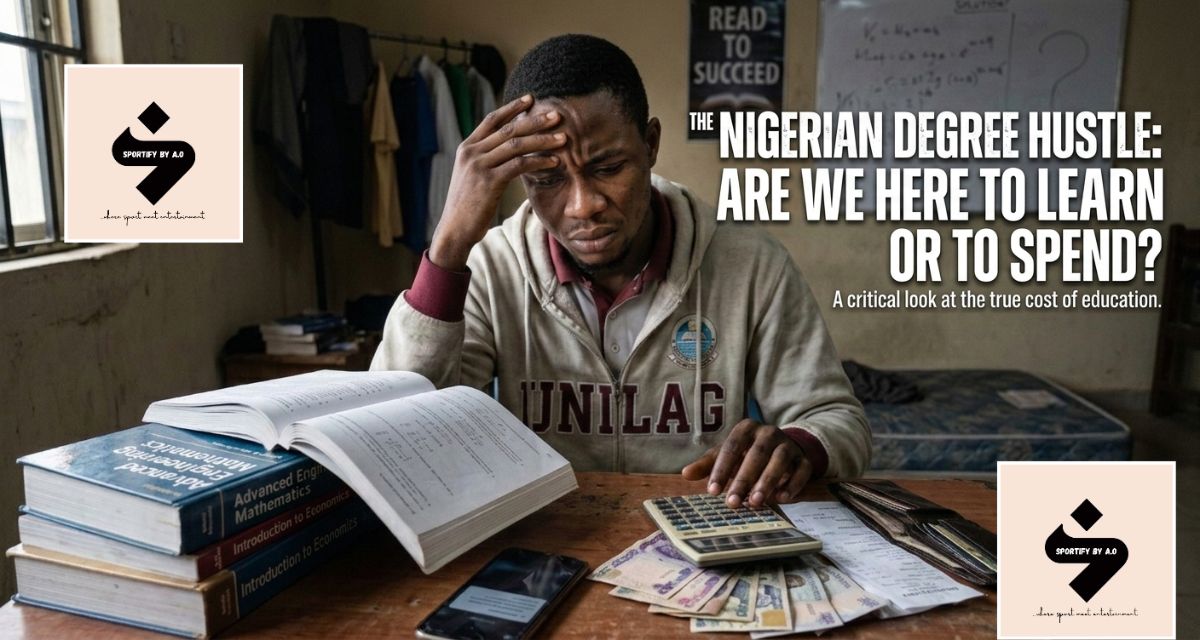
When you factor in skyrocketing "miscellaneous" fees, the cost of handouts, project materials, accommodation, and the ever-present "hidden" costs of survival on campus, it feels like we are paying a premium for the privilege of being stressed.
The Spending Curve: Often steep and unforgiving.
The Learning Curve: Frequently hampered by outdated curricula, overcrowded lecture halls, and infrastructural deficits.
When the financial burden becomes the primary focus of a student’s life, it inevitably cannibalizes the mental bandwidth required for deep, critical learning. You cannot master advanced calculus or constitutional law when you are perpetually calculating if you can afford another week of transport fare.
Is It Still About the Certificate or the Knowledge?
We have to ask the difficult question: Are we in school to actually learn, or are we just funding a system to eventually hold a piece of paper?
The reality is that for many, the "spending" has become an investment in survival rather than skill acquisition. We are paying to endure a system that often prioritizes bureaucracy over pedagogy. When the process of getting a degree becomes a financial drain that leaves you exhausted, the actual "learning" often gets relegated to the back seat.
Breaking the Cycle
If we want to change this narrative, we need to shift the focus back to value. Education should be an equalizer, not a financial sieve.
For Institutions: It’s time to modernize curricula and prioritize student well-being over redundant administrative fees.
For Students: It requires resilience i.e “finding ways to bridge the gap between classroom theory and real-world skills through self-teaching and digital resources, even when the system makes it hard.”
The question remains: Are we in school to learn or to spend? Perhaps, for now, we are doing both, but we must fight to ensure that the learning is what truly lasts long after the money is gone.