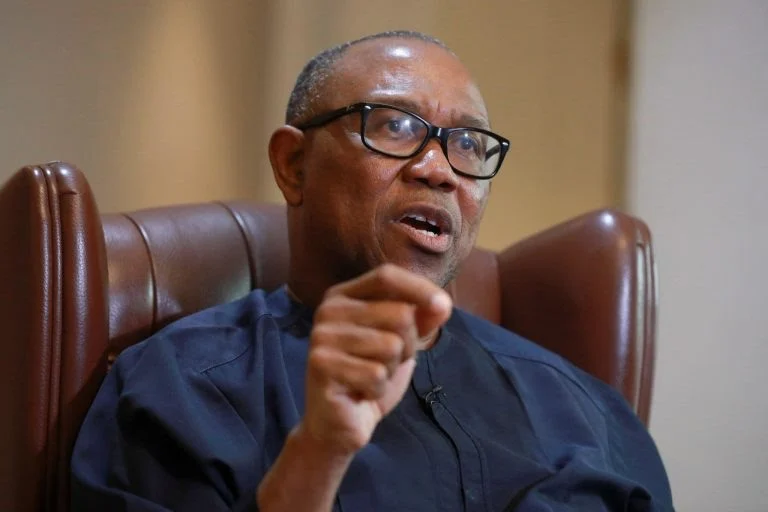
Former Anambra State governor and Labour Party presidential candidate Peter Obi has accused President Bola Tinubu’s administration of plunging many of its own supporters into economic ruin, saying some who once ran viable businesses have now been reduced to selling kuli-kuli, a popular groundnut snack, to survive.
Speaking in a long-form interview with media entrepreneur Chude Jideonwo, Obi argued that the economic realities under Tinubu have eroded the optimism that powered the president’s 2023 campaign and reshaped public opinion across party lines.
Obi insisted that his own support base has not diminished since the election, but has grown as Nigerians, including former Tinubu supporters, reassess their choices in light of worsening hardship.
“Those who had business when he came into power have collapsed. They are now the people who are selling kuli-kuli?” he said, using the image to illustrate how far many have fallen in a short time.
He maintained that Nigerians can no longer be persuaded that things are improving, pointing to rising poverty, hunger and insecurity as evidence that the government’s “Renewed Hope” agenda has failed to deliver.
“Nobody can tell you things are moving well,” Obi said, adding that what was sold as hope has, in his view, “become hopelessness” since Tinubu assumed office.
Obi claimed that poverty levels and hunger rankings have worsened, arguing that the statistics now mirror what citizens feel in their daily lives. “Everything has gotten worse. We’re no longer talking of ghosts walking around. You can see where we’ve gotten,” he said.
He also rejected suggestions that the enthusiasm of his 2023 “Obidient” movement has waned, saying more Nigerians are now aligning with his message after experiencing the consequences of the election outcome. “My fellowship has increased,” he said, framing the shift as a verdict on governance rather than on campaign rhetoric.
Obi further defended his political alignment with former Kano State governor Rabiu Kwankwaso, describing him as one of the few politicians genuinely committed to lifting people out of poverty and educating “the child of nobody to become something.”
Reiterating his long-standing emphasis on human capital, Obi argued that education and healthcare, not grand physical projects, are the real engines of development, citing Asian economies such as China and Malaysia as models. He said his vision remains a productive Nigeria where citizens have the skills and opportunities to escape poverty, rather than one where former business owners are pushed into street-level petty trade.