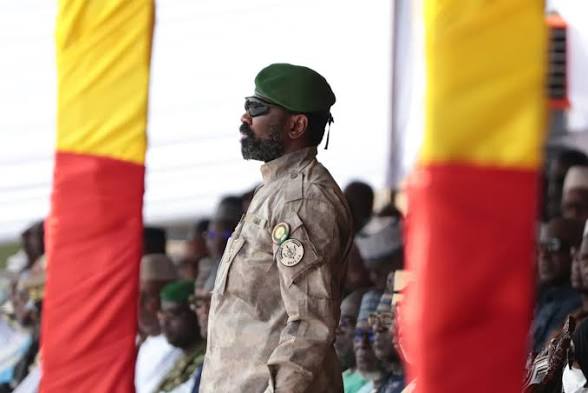
Mali’s already fragile military regime has been rocked by a dramatic and deadly shake-up, with junta leader Assimi Goita seizing the powerful defence portfolio just hours after his own defence minister was killed in a brazen car bomb attack.
The announcement, read out on tightly controlled state TV, cements Goita’s status as Mali’s undisputed strongman. The colonel, who came to power through a coup, is now not just the head of state but also the man directly in charge of the country’s war machine.
The trigger for this power grab was the assassination of Defence Minister Sadio Camara, a key architect of the junta and one of Goita’s closest allies. Camara was killed when a car bomb exploded at his residence, part of a coordinated offensive that struck at the heart of the regime’s security apparatus.
The attacks, claimed by Tuareg separatists and Al-Qaeda-linked militants, have been described as one of the most serious blows to Mali’s state authority in years. They didn’t just kill a top minister; they exposed how vulnerable the junta really is.
Armed groups went further, capturing the strategic northern town of Kidal, a long-contested symbol of power in Mali’s desert north. Losing Kidal is more than a military setback; it is a public humiliation for a regime that has repeatedly promised to restore territorial control.
Initial death tolls from the offensive stand at at least 23 people, with reports that civilians and children are among the dead and wounded. The violence has once again dragged ordinary Malians into the crossfire of a conflict they have no control over.
The operation was carried out by the Group for the Support of Islam and Muslims, Al-Qaeda’s Sahel affiliate known as JNIM, working in tandem with the Azawad Liberation Front, a Tuareg separatist movement. Their targets were clear: Malian forces and their controversial Russian allies, the cornerstone of Goita’s security strategy.
In a move clearly designed to project strength and continuity, Goita named General Oumar Diarra, the former armed forces chief of staff, as minister delegate to the defence minister. In practice, Diarra is now Goita’s number two in a defence structure that is increasingly concentrated around the junta leader himself.
The militants, emboldened by their success, have gone further by announcing a blockade of the capital Bamako. They claim it is punishment for what they call popular support for the army, turning the regime’s own propaganda about public backing into a weapon against it.
On the ground, the so-called blockade has translated into sporadic ambushes and threats along key highways rather than a full siege. But the psychological impact is undeniable: fear, rumours and uncertainty are spreading faster than verified information.
Security officers patrolling the crucial Kayes–Bamako road describe a tense “cat and mouse” game, with no one sure where the next attack might come from. The sense of insecurity is so strong that some transport companies, including on the Bamako–Sikasso route, have suspended services altogether.
Travellers who do risk the journey report long detours, endless delays and trips made, in their own words, “with knots in our stomachs.” For many, the roads that once connected the country are now corridors of anxiety.
By taking direct control of the defence ministry, Goita is sending a clear message: he is tightening his grip as the crisis deepens. But the move also exposes the regime’s vulnerability. A junta that promised security is now fighting for its own survival, on multiple fronts, against enemies who have just shown they can strike at the very core of its power.