The editing suite in Surulere smelled of burnt coffee and old cable insulation. Udoka had stared at the same forty-second clip for three hours: a woman standing at a bus stop in Yaba, waiting, saying nothing.
“It’s boring,” Chike, the director, said from the doorway. “Nothing happens. Maybe we should cut it.”
Udoka never looked up.
“Nothing happens because you’re listening to nothing. Give me till tomorrow.”
Chike left.
She stayed.
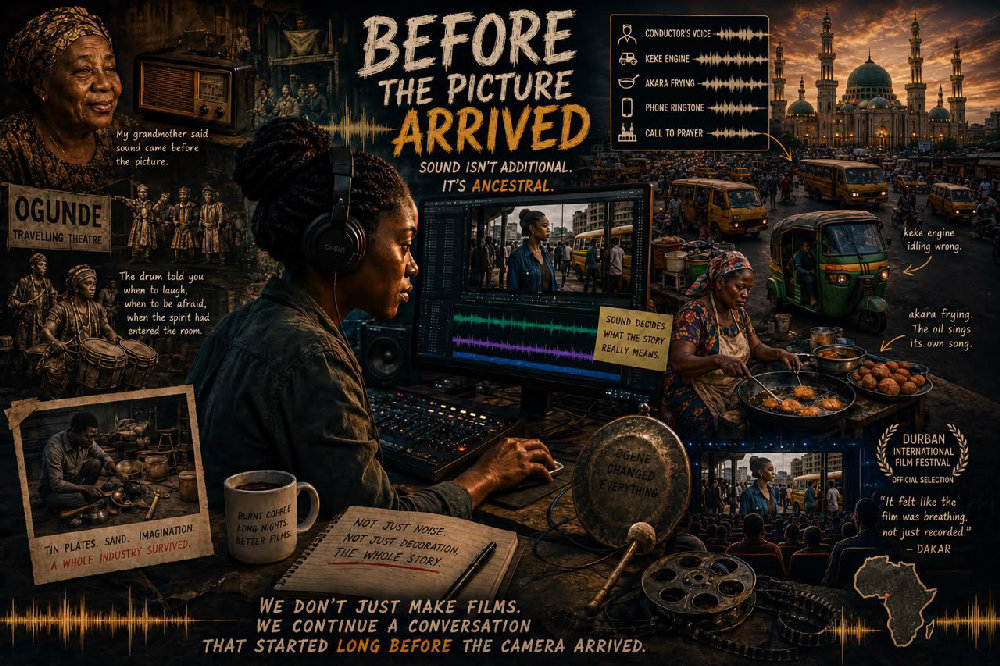
Udoka grew up in Aba, where her grandmother kept an old transistor radio permanently tuned to highlife music. On quiet nights she told stories of Hubert Ogunde, Duro Ladipo, and the travelling theatre troupes that crossed West Africa.
“The drum was never decoration,” she always said. “It told you when to laugh, when to fear, and when the spirits had entered the room. Sound came before the picture. The griot spoke long before anyone built a screen.”
As a child, Udoka never understood.
Years later, in film school, a lecturer screened a worn VHS copy of an early Nollywood film. Shot on cheap video cameras and sold through Alaba Market, it had been dubbed quickly because there was neither money nor time for proper location sound.
Every footstep.
Every door.
Every breath.
Had been recreated later by a Foley artist with little more than tin plates, wooden sticks, and a bucket of sand.
“Our industry survived because of this,” the lecturer said. “Even when the picture failed, sound carried the emotion.”
Back then, Udoka dismissed it as an excuse for poor filmmaking.
Now she knew better.
She muted the temporary piano track Chike had downloaded and listened instead to the raw audio recorded in Yaba.
A conductor shouting destinations.
A keke engine struggling to idle.
The gentle hiss of akara frying beside the road.
A Burna Boy ringtone from somewhere outside the frame.
The distant call to prayer fading beneath Lagos traffic.
None of it had been planned.
All of it belonged to the story.
She rebuilt the scene using those sounds alone.
For ten seconds she changed nothing, letting Lagos breathe around the silent woman.
Then she slowly peeled sounds away.
The traffic softened.
The frying oil disappeared.
Only the conductor’s voice remained, repeating until it sounded less like a route call and more like a heartbeat.
Beneath everything, almost impossible to hear, she added a low ogene note recorded during a masquerade festival in Nnewi for a documentary that was never completed.
There was no masquerade in this film.
No village.
No spirits.
Yet the iron resonance transformed the moment.
Waiting became ceremony.
The woman at the bus stop no longer looked lost.
She looked as though she stood at the threshold of another life.
No dialogue explained it.
None was needed.
At two in the morning, Udoka exported the scene and sent it to Chike without a message.
Her phone rang at six.
“I’ve watched it four times,” he said quietly. “It’s the same footage, but it feels completely different.”
“It’s the same picture,” Udoka replied. “Before, it didn’t have sound. It had noise.”
She paused.
“You kept telling me the woman had decided to leave her husband. That was your decision as director. But sound has to make decisions too. Otherwise it’s only documentation.”
Silence settled between them.
For once, it felt full.
“My father acted with one of the Yoruba travelling theatre companies,” Chike finally said. “He always claimed the drummer was the second director. If the drum didn’t agree a scene had ended, the audience never believed it.”
Udoka smiled.
“You already knew this,” she said. “You just forgot it lived in your body before it lived in a textbook.”
The film was small.
Self-funded.
Shot on weekends between ordinary jobs.
Eighteen months later it screened at a film festival in Durban alongside films from Kenya, Senegal, and Egypt.
Udoka watched from the back of the cinema.
When the bus-stop scene arrived, nearly three hundred strangers leaned forward at the exact moment the ogene entered.
The theatre became still.
After the screening, a woman from Dakar approached her.
“It felt like the film was breathing,” she said. “How did you build the sound?”
Udoka tried to explain the layering, the ogene, and the way silence argued with city noise instead of hiding it.
Then she stopped.
“I just tried to remember,” she said, “that on this continent, sound was never decoration for the picture. Sometimes it was the whole story, and the picture was decoration for it.”
The woman smiled.
“My students mix sound like it’s an apology for the image,” she said. “Would you speak to my editing class someday?”
“Of course,” Udoka replied.
As they walked toward the festival lobby, she paused.
Somewhere in her memory, her grandmother’s old transistor radio was still playing highlife into the night. The melodies carried voices, drums, laughter, and stories that had lived long before cinema
And in that quiet moment,udoka finally understood what her grandmother had been teaching her all along.
Sound always known the way before pictures arrived cinema.
And in that quiet moment, Udoka finally understood what her grandmother had been teaching her all along.
Sound had always known the way before the picture arrived.
6