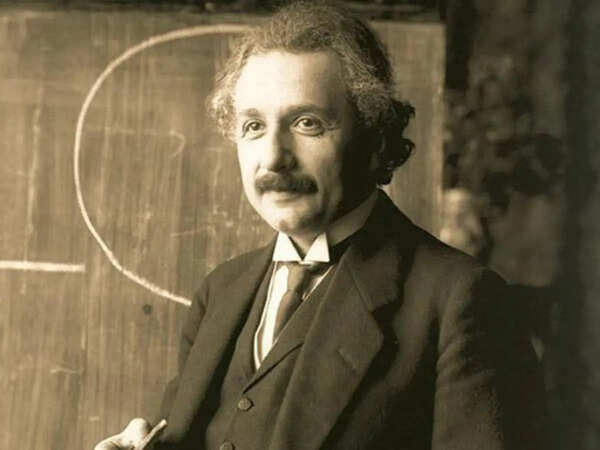
When people talk about parenting and early education, there are always debates about what truly helps children become intelligent. Some focus on academic discipline, some on structured learning, and others on emotional development. Amid all this, one short phrase often attributed to Albert Einstein offers a very different angle on learning and intelligence. It connects something as simple as storytelling with how a child’s mind develops over time.Fairy tales are built on worlds that do not exist in real life. Talking animals, magical events, impossible journeys, and symbolic characters form the core of these stories. For a child, engaging with such narratives forces the mind to go beyond literal thinking. They begin to imagine situations, connect meanings, and mentally construct worlds that are not physically present.
This process is important because intelligence is not only about memorising facts or solving textbook problems. It also includes the ability to think in abstract ways, to understand patterns, and to interpret situations that are not straightforward. The quote is essentially suggesting that imagination is not separate from intelligence, but a part of it.Albert Einstein: the thinker behind the idea
Albert Einstein was born on March 14, 1879, in Ulm, Germany. His family later moved to Munich, where he spent part of his early education. From a young age, he showed curiosity in mathematics and science, although he did not always fit into traditional schooling systems comfortably.
He later moved across Europe, continuing his studies in Italy and Switzerland. In 1896, he joined the Swiss Federal Polytechnic School in Zurich, where he trained in physics and mathematics. After graduation, he struggled to find a teaching position and eventually began working at the Swiss Patent Office in Bern.Einstein’s thinking style and belief in imagination
Einstein’s approach to science was not purely mechanical or mathematical. He often relied on thought experiments and visual imagination to develop ideas. Instead of only working through equations, he would imagine scenarios in his mind and explore how physical laws would behave in those situations.
This way of thinking is quite important when understanding why he valued imagination. For him, imagination was not something separate from logic. It was part of the process that leads to discovery.
He believed that knowledge alone had limits if it was not supported by creative thinking. This is why the quote about fairy tales is often linked to his broader philosophy. Fairy tales, in a sense, act as early exercises in imaginative thinking, especially for children whose understanding of the world is still forming.
Why the idea matters in modern education
In today’s environment, children are exposed to structured learning, digital platforms, and fast-paced content from an early age. While these tools have value, the role of storytelling has not lost its importance.
Fairy tales and similar stories provide something that modern formats often do not: slow thinking. They allow children to sit with ideas, imagine situations, and process emotions without time pressure. This kind of engagement supports deeper mental development over time.
Even in educational psychology today, imagination is linked with problem-solving ability, creativity, and emotional intelligence. Children who are encouraged to think beyond literal explanations often develop stronger adaptability when facing unfamiliar situations later in life