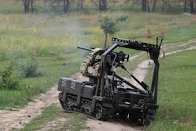
Ukraine has introduced a new battlefield tactic by using a heavy-lift drone to transport a combat ground robot behind enemy lines, in what is believed to be the first recorded attack of its kind.
During the operation, a heavy-lift drone carried an ARK-1 unmanned ground vehicle (UGV) armed with an anti-tank mine. The strategy, often described as a "marsupial" approach, allows one autonomous system to carry another into locations that are difficult or risky to access. The method highlights the growing role of coordinated unmanned systems in modern warfare while helping reduce the exposure of soldiers to danger.
Although the United States has experimented with similar concepts for years, the idea largely remained in the testing phase. Ukraine has now put the approach into real combat, demonstrating its practical military value.
The tactic also addresses the range and mobility limitations of smaller first-person view (FPV) drones. Ukraine has already tested several "mothership" drones capable of carrying and releasing smaller drones closer to their targets. Ground robots have also been adapted to deploy FPV drones, while unmanned surface vessels have been used as floating launch platforms for aerial drones during attack and interception missions.
According to Ukrainian engineer Eduard Trotsenko, founder of robot manufacturer Temerland, the rapid advancement of battlefield robotics is primarily aimed at protecting soldiers' lives. He noted that robots are increasingly taking on dangerous tasks that would otherwise put troops at risk.
Today, many ground robots are used to evacuate wounded personnel and deliver supplies across hazardous terrain. Trotsenko is also developing combat variants equipped with weapons such as RPG launchers and heavy machine guns. Some of these systems are currently undergoing field testing with Ukrainian military brigades while awaiting broader approval.
A Ukrainian commander identified by the call sign "Jason" said one of the greatest advantages of robotic systems is that equipment can be replaced, while human lives cannot. He explained that relying on drones significantly lowers the likelihood of troop casualties during dangerous missions.
Ukraine's push toward battlefield automation has been strongly backed by former Defence Minister Mykhailo Fedorov, who established the Defence AI Center A1 to speed up the integration of artificial intelligence into military operations. He also promoted close cooperation between private technology firms and the armed forces, allowing engineers to rapidly improve systems based on frontline feedback.
Trotsenko said much of Ukraine's innovation has come from independent engineers rather than top-down government planning. Young developers have worked directly with soldiers to refine new technologies, leading to closer collaboration between programmers, telecommunications experts, engineers and the military.
Despite the rapid progress, challenges remain. Jason noted that the shortage of trained personnel continues to limit wider deployment of these systems. Looking ahead, Trotsenko believes future conflicts could feature remotely operated humanoid robots controlled from far away, reflecting the rapid evolution of military robotics.