The first time Kene directed a short film, he believed the camera was everything.
He spent weeks borrowing a DSLR from a friend, searching for beautiful locations around the university, and making sure every shot looked cinematic. The lighting was perfect. The costumes were convincing. When the editing was complete, he invited his classmates to watch.
The room was silent—not because they were amazed, but because they were confused.
"Why didn't I feel anything?" one of them asked.
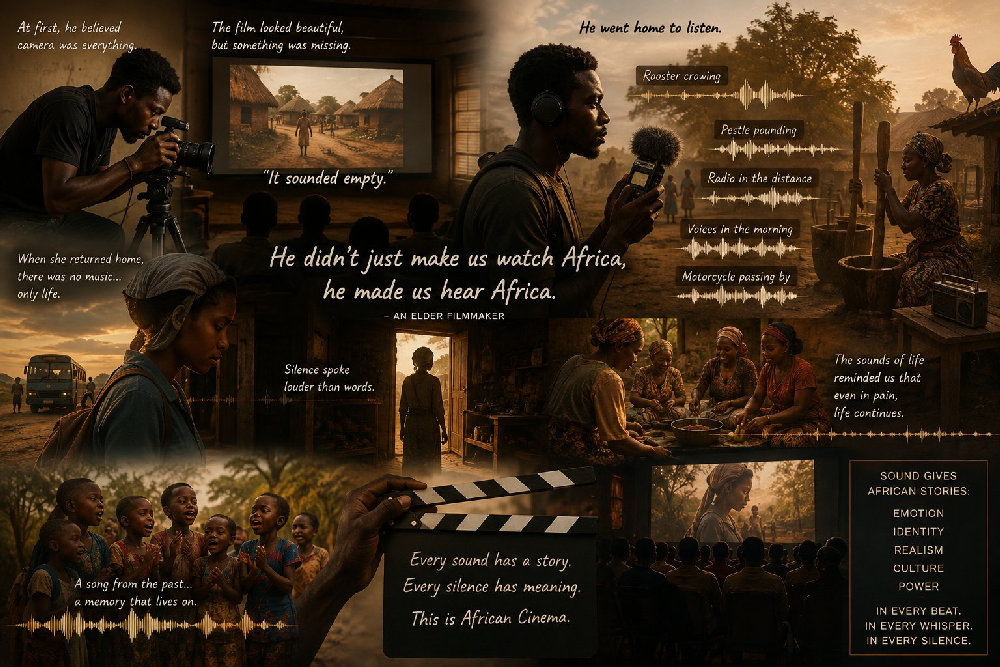
Another simply said, "It looked beautiful... but it sounded empty."
Those words stayed with Kene.
Determined to understand what was missing, he returned to the village where his grandmother lived. He carried only a small recorder this time. He wasn't interested in filming. He wanted to listen.
Before sunrise, the village was already awake. A rooster crowed from a distance. Pestles struck mortars in different compounds. A radio played old highlife songs somewhere behind the trees. A woman called out to her children in Tiv, and a motorcycle engine struggled through the muddy road before disappearing into the morning.
Kene closed his eyes.
For the first time, he realised that home had a soundtrack.
Months later, he started another film. It told the story of a young woman returning home after losing her father. There were very few conversations. Instead, he allowed sound to speak.
When she stepped down from the bus, there was no music—only the wind brushing through dry maize stalks and the squeak of her travelling bag. As she approached her father's empty workshop, the audience heard the rusty door groan open, followed by complete silence. That silence was louder than any dialogue. It carried grief that words could never explain.
In another scene, village women gathered to prepare food after the funeral. Their laughter slowly blended with the rhythm of pestles hitting mortars. Without anyone saying it aloud, the audience understood that life, despite pain, was continuing.
Towards the end of the film, children began singing an old folk song Kene's grandmother used to sing. It was not added because it sounded beautiful. It belonged to that community. It carried memory, identity, and history. Some viewers wiped tears from their eyes, reminded of villages they had not visited in years.
After the screening at a student film festival, an elderly filmmaker walked up to Kene.
"You didn't just make us watch Africa," he said with a smile. "You made us hear Africa."
That sentence became Kene's greatest award.
He finally understood that modern African cinema is not only built with cameras and actors. It is built with sounds that audiences recognise—the beat of local drums, the voices in indigenous languages, market noise, church choirs, evening insects, rain on zinc roofs, and even moments of complete silence. These sounds give films emotion, preserve culture, create realism, and connect viewers to experiences they may never see but can instantly feel.
From that day on, whenever Kene planned a film, he never asked, "What should the audience see?"
He first asked, "What should they hear?"
6