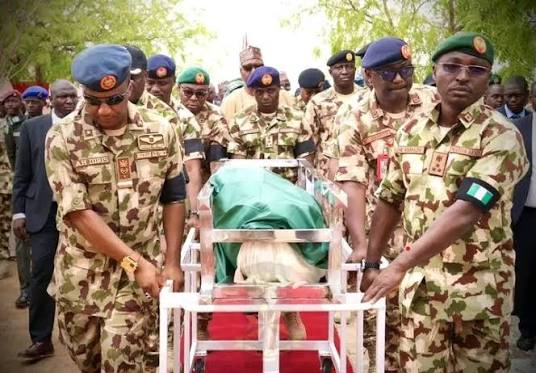
Rows of flag-draped coffins lay in the red earth of Maimalari Cantonment Cemetery as the Nigerian army buried officers and soldiers killed in recent Islamist militant attacks in the country’s northeast. The ceremony, heavy with military ritual and private grief, underscored the human cost of a conflict that has raged for more than a decade.
Among the dead was Brigadier General Omo Braimah, the most senior officer to fall in the latest wave of violence. His coffin, borne by a guard of honour, led the procession as troops fired volleys into the air in a final salute. Senior commanders, families and comrades watched in silence, some wiping away tears, others standing rigidly at attention.
Defence Minister General Christopher Gwabin Musa told mourners that the fallen would be honoured not only with ceremony but with a renewed determination to defeat the insurgents who killed them. The best way to honour General Braimah and these fallen heroes, he said, is to finish the task they gave their lives for.
The soldiers were killed when suspected Boko Haram and Islamic State West Africa Province fighters mounted coordinated assaults on military positions along the Maiduguri–Damaturu highway, a strategic route that has long been a target for ambushes and bomb attacks. The highway links key population centres in Borno and Yobe states and is vital for civilian movement and military logistics.
Musa also used the burial to defend a recent airstrike on the Jilli market area, where scores of civilians were reportedly killed. He insisted the operation targeted a gathering of Boko Haram fighters. Anybody who knows Jilli, he said, knows it has been banned and closed for a while, and anybody in that area is a criminal.
Rights groups dispute that account. Amnesty International has called for an independent investigation, accusing the military of a pattern of describing civilian casualties as bandits or insurgents. The incident has reignited debate over the conduct of counterinsurgency operations and the balance between security imperatives and civilian protection.
Nigeria, Africa’s most populous nation, faces a complex security crisis, particularly in the north, where Boko Haram, its Islamic State–aligned offshoot ISWAP, and other armed groups such as the IS-linked Lakurawa faction operate across vast, often poorly governed territories. Kidnappings for ransom, village raids and attacks on security forces have become grimly routine, even as the army continues to count its dead.