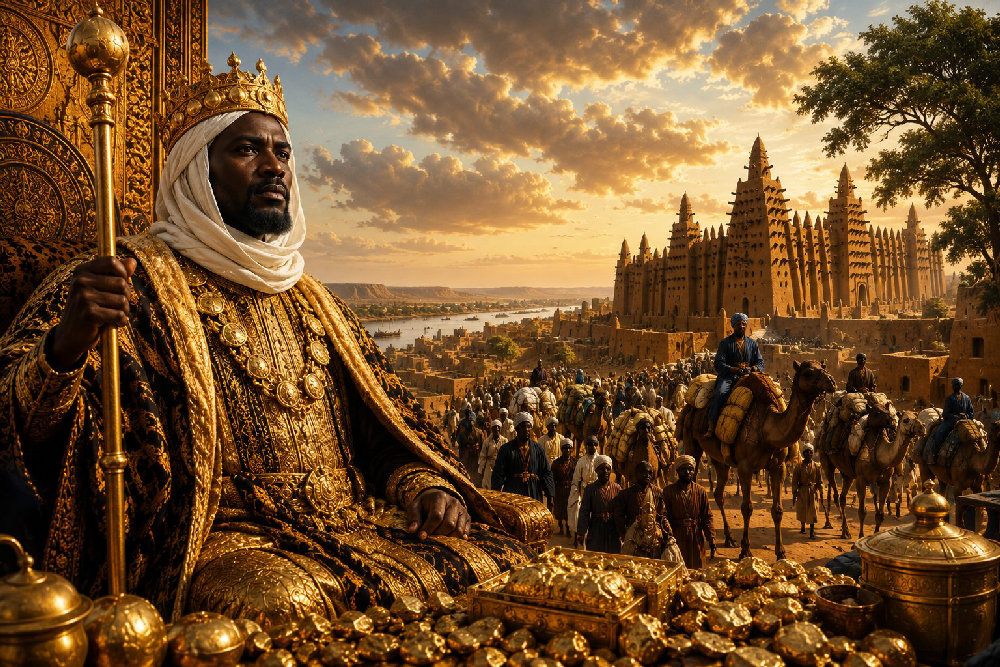
When people think of the richest people in history, names like Elon Musk, Jeff Bezos, or Bill Gates usually come to mind. But long before any of them existed, there was an African king whose fortune was so extraordinary that historians still believe no modern billionaire has truly matched it. His name was Mansa Musa, the legendary emperor of the Mali Empire.Mansa Musa ruled the Mali Empire from 1312 to 1337, during a time when it was one of the largest and wealthiest empires in the world. Stretching across much of present-day Mali, Senegal, Guinea, Niger, and neighboring regions, the empire controlled some of the most important trade routes in Africa. It was also home to vast gold mines that supplied a significant share of the world's gold at the time.Because of this, Mali became a center of commerce, attracting merchants from North Africa, the Middle East, and beyond. Gold, salt, ivory, and other valuable goods flowed through the empire, making Mansa Musa incredibly wealthy.
The Pilgrimage That Made the World Take Notice
In 1324, Mansa Musa set out on a pilgrimage (Hajj) to Mecca. While the journey itself was an important religious obligation for Muslims, the scale of his expedition became the stuff of legend.Historical accounts describe a caravan of thousands of people, including soldiers, servants, officials, and attendants. Hundreds of camels reportedly carried loads of gold, along with food, clothing, and other supplies for the long journey across the Sahara Desert.As Mansa Musa traveled through cities such as Cairo, he gave generously to the poor, donated to religious institutions, rewarded local leaders, and spent lavishly in local markets. His generosity became so famous that many historians report the sudden influx of gold contributed to a decline in its value in parts of the region for years afterward.Whether every detail of these accounts is exact is still debated by historians, but there is broad agreement that his pilgrimage dramatically increased the world's awareness of the Mali Empire.
More Than Just a Wealthy King
Although Mansa Musa is best remembered for his immense fortune, his greatest achievement may have been how he invested it.After returning from Mecca, he funded the construction of mosques, libraries, and schools throughout his empire. He invited architects, scholars, and teachers from different parts of the Islamic world to help develop Mali's cities.His support helped transform Timbuktu into one of the world's leading centers of learning. Students traveled there to study subjects such as mathematics, astronomy, medicine, law, literature, and theology. The city's libraries housed thousands of manuscripts, many of which are still preserved today.
A Legacy That Lives On
Mansa Musa's influence reached far beyond West Africa. His famous pilgrimage placed the Mali Empire on maps used by European and Middle Eastern cartographers, introducing many people to the empire's wealth and importance.Today, he is widely regarded as one of the wealthiest individuals in history. Yet his legacy is about more than gold. He showed that lasting influence comes from investing in education, culture, infrastructure, and the growth of society.Centuries later, Mansa Musa remains a powerful symbol of African excellence, leadership, and vision. His story reminds us that true greatness isn't measured only by what we possess, but by the impact we leave behind.