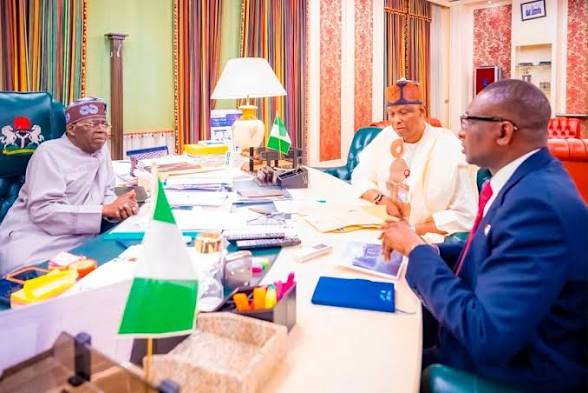
President Bola Ahmed Tinubu has met with the Executive Chairman of the Economic and Financial Crimes Commission, Olanipekun Olukoyede, and the Minister of Housing and Urban Development, Muttaqha Rabe Darma, to review how houses seized from corruption cases are managed and disposed of across the country.
The closed-door meeting, held at the State House in Abuja, focused on creating a transparent, accountable framework for converting confiscated real estate into public value. According to the Presidency, the discussion centred on ensuring that forfeited properties do not lie idle, deteriorate, or quietly return to the control of those from whom they were seized.
Presidential aides indicated that Tinubu is pushing for a clear, rules-based process that will subject the disposal of such assets to public scrutiny, competitive bidding, and traceable remittance of proceeds into government coffers. The President is also understood to be considering how some of the properties could be repurposed for social housing, public institutions, or other priority infrastructure, rather than sold off entirely.
The engagement is particularly significant given the EFCC’s long-standing challenge of managing a growing inventory of seized assets, including luxury homes, estates, and commercial buildings scattered across major cities. Many of these properties have been tied up in lengthy court processes, while others, though finally forfeited, have suffered neglect, vandalism, or opaque disposal.
By bringing the Housing and Urban Development Ministry formally into the conversation, the Presidency is signalling a shift from ad hoc asset disposal to a more coordinated national policy that links anti-corruption enforcement with urban planning and housing needs.
Analysts say the move could help rebuild public confidence in the anti-graft war, where questions have frequently been raised about who ultimately benefits from recovered assets. A transparent disposal regime, they argue, would not only deter corruption but also demonstrate tangible returns to citizens in the form of housing, infrastructure, or clearly accounted revenue.
Presidential sources suggest that a technical framework is now being drafted, with input from the EFCC, the housing ministry, and relevant justice sector agencies, to standardise valuation, documentation, auctions, and public reporting on all seized real estate going forward.





.jpeg?alt=media&token=96b327a5-8e62-4ed1-a078-308aff149ed1)