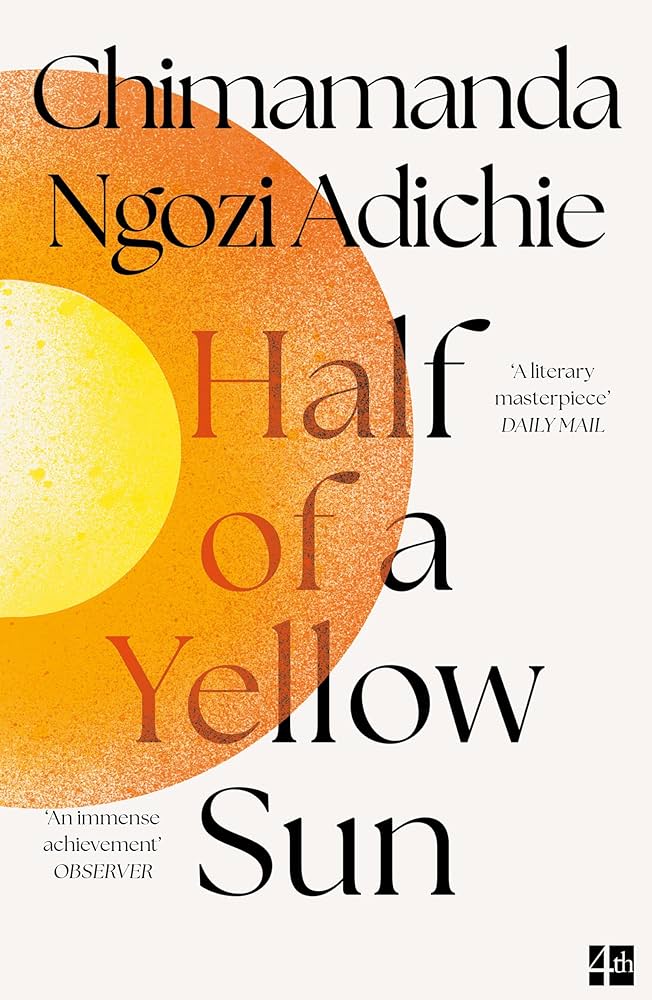
I started reading *Half of a Yellow Sun* two weeks ago — my first time patiently taking in a Chimamanda piece — and I finished it yesterday. Hurray!
Throughout my read, one thought clung to the back of my mind: this woman is no ordinary storyteller. To think that she wrote a story she didn’t experience firsthand, breathing so much life into it that any intentional reader would feel like they were part of everything, is absolutely magical.
I could vividly imagine every character, every action, every scene, and every atmosphere. This imagery, especially, made everything real; Olanna’s skin, Odenigbo’s hair, Kainene’s nonchalance, Richard’s awkwardness, Ugwu’s naivety, Harrison’s food show-off, Jomo’s expertise in the garden and many more.
None of them was immortal, and none was disappointing. I remember how each atmosphere controlled my emotions: Mama’s outburst at Olanna, Olanna seeing the bodies of her aunt and uncle, the head in the calabash on her way back from Kano, the events surrounding Baby’s birth, their (Olanna & Odenigbo’s) first evacuation from Nsukka (I can still remember the soup they packed hurriedly — their last good meal in many years), their relocation afterwards, Odenigbo’s reaction to his mother’s death, Ugwu’s conscription, Ikejide’s death, Anulika’s rape, and most painfully, Kainene’s unresolved disappearance till the end of the book.
Strangely, I like Kainene’s character the most. Her closed-mindedness, neutral and plain responses, composure, and steadfastness. I really admire her, till the very end.
Though much of her thoughts weren’t disclosed, she seemed the strongest and toughest. Her humor remained the same from the start till the end. A part of me left with the story — curious to know how many years it took to find Kainene. I’m never going to recover from that heartbreak. But life happens.
Overall, the story is history. One that must be transmitted without stop. All generations should know the story — the true story of the brave and strong Easterners who, with nothing, fought relentlessly for their freedom. With fear and faith, they lived through the most torturous period of their lives. Their story lives on.



