The studio was quiet, but inside Kofi’s headphones, his late father was still breathing.
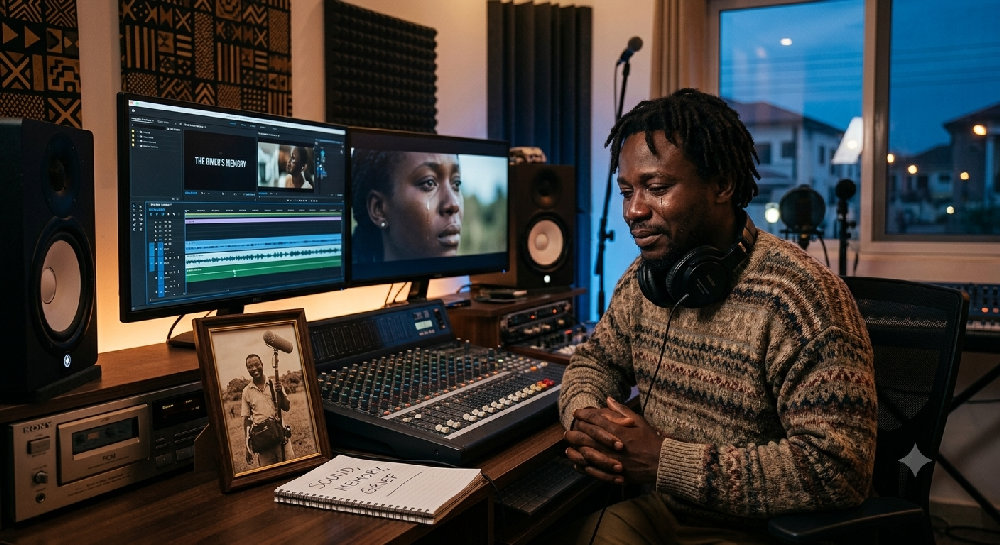
Kofi sat alone in the editing suite in Accra, the pale light of his timeline illuminating the tears dried on his cheeks. He was cutting the final scene of "The River’s Memory", a story about a family coming to terms with loss along the Volta River.
It was a personal film, made all the more raw because his father,a veteran field recordist who taught Kofi everything about audio ,had passed away just weeks before post-production began.
On screen, the protagonist stood at the edge of the water at dusk, paralyzed by grief, unable to weep.
Kofi’s first instinct had been to flood the scene with a melancholic string quartet, standard dramatic fare designed to pull tears from the audience. But he paused, remembering his father’s voice:
"Pain doesn't always play a violin, Kofi. Sometimes grief is just the quietest thing in the room."
Modern African cinema had moved past heavy-handed, manipulative soundtracks. Directors like Oge Obasi and Mati Diop had proved that constraint and subversion could cut far deeper into the human psyche.
Kofi muted the music entirely.
He stripped away the ambient hiss of the track. Suddenly, the room in the head phones collapsed into a dense, suffocating silence. In that silence, he amplified only one element: the sharp, jagged hitch of the protagonist’s breath.
It wasn't just sound design; it was an emotional stethoscope. The audience wasn't just watching a character grieve; they were forced to share the exact air trapped in her chest.
Next came the water.
In older films, water sounds were generic—imported stock files of clean, distant waves that felt cold and detached. But modern sound design treats environment as an emotional character.
Kofi opened an old audio folder labeled Volta_Field_1998”recordings his father had captured decades ago on an analog tape deck.
He pulled a track onto the timeline. Instantly, the headphones filled with the deep, visceral 'thrum' of river water hitting wooden fishing boats, the delicate rustle of tall grass, and the low, haunting whistle of wind passing through reeds.
Because modern recording technology allows for extreme frequency layering, Kofi EQ'd the sound so the low frequencies subtly vibrated—a physical sensation of sorrow felt in the viewer's chest rather than heard in their ears. The river didn't just sound like water; it sounded like memory. It carried the weight of ancestral history, pulling the protagonist and the audience into a realm where the past and present existed simultaneously.
To break the protagonist's paralysis, Kofi needed a shift.
Instead of a traditional film score, he introduced a quiet, diegetic element from far down the riverbank: the faint, rhythmic pounding of a *Fontomfrom* drum, played not for celebration, but for a traditional mourning ritual.
He didn't mix it loud. It drifted in like a distant heartbeat, gradually aligning with the rhythmic pattern of the protagonist's breathing.
As the drum beat merged with a soft, mournful vocal hum a traditional lament recorded live in a nearby village a single tear fell from the character’s eye on screen.
The sound hadn't forced the emotion; it had invited it. It bridged the gap between personal, isolated pain and the collective comfort of community and tradition a defining hallmark of contemporary African storytelling.
Kofi pulled off his headphones and let them rest around his neck.
In the quiet of the studio, he realized what modern African cinema’s audio revolution really meant. It wasn't just about better microphones or high-tech spatial audio. It was about reclaiming the emotional landscapeusing native sounds, subtle silences, and authentic cultural rhythms to make the world feel the true, unvarnished heartbeat of the continent.
He pressed play one last time, turned up the master volume, and let the sound of his father’s river fill the room.
4