If you've attended a Nigerian university, you'll know that some battles aren't with lecturers.
They're with network providers.
Mine happened on the day I was supposed to submit my final-year project.
After months of research, countless corrections from my supervisor, sleepless nights, and enough money spent on printing, photocopying, and binding to make me question my life choices, I was finally at the finish line.
All I had to do was upload my project before the deadline.
That's all.
Or so I thought.
The deadline was 12 noon.
By 9 a.m., I was already awake. I had checked the document more times than I could count.
Was my name spelled correctly?
Was my matric number correct?
Did I save the final version or the one with mistakes?
I checked everything again.
Satisfied, I bought a fresh data bundle. I wasn't about to let "insufficient data" become my excuse.
At exactly 10:15 a.m., I opened the submission portal.
I selected my project.
Clicked Upload.
Then I waited.
And waited.
Nothing.
The upload bar didn't even move.
I refreshed the page.
Nothing.
I switched from MTN to Airtel.
Still nothing.
I turned my hotspot off and back on.
Nothing.
I even moved around the room looking for the "best network spot" as if signal was hiding in one particular corner.
Still nothing.
At first, I wasn't worried.
"There are still almost two hours left," I told myself.
But two hours can disappear very quickly when the internet decides it has its own plans.
By 11 a.m., my confidence had vanished.
The departmental WhatsApp group was in chaos.
“Has anyone submitted?”
“The portal isn't opening.”
“Mine is saying network error.”
“Please, has the deadline been extended?”
Some students claimed they had submitted successfully.
Others insisted the portal had crashed.
Nobody knew who to believe.
Panic spread faster than the messages.
One of my roommates looked at me and said, “Go to a cyber café. Don't risk it.”
I didn't argue.
I grabbed my laptop, charger, phone, power bank, and practically ran out of the hostel.
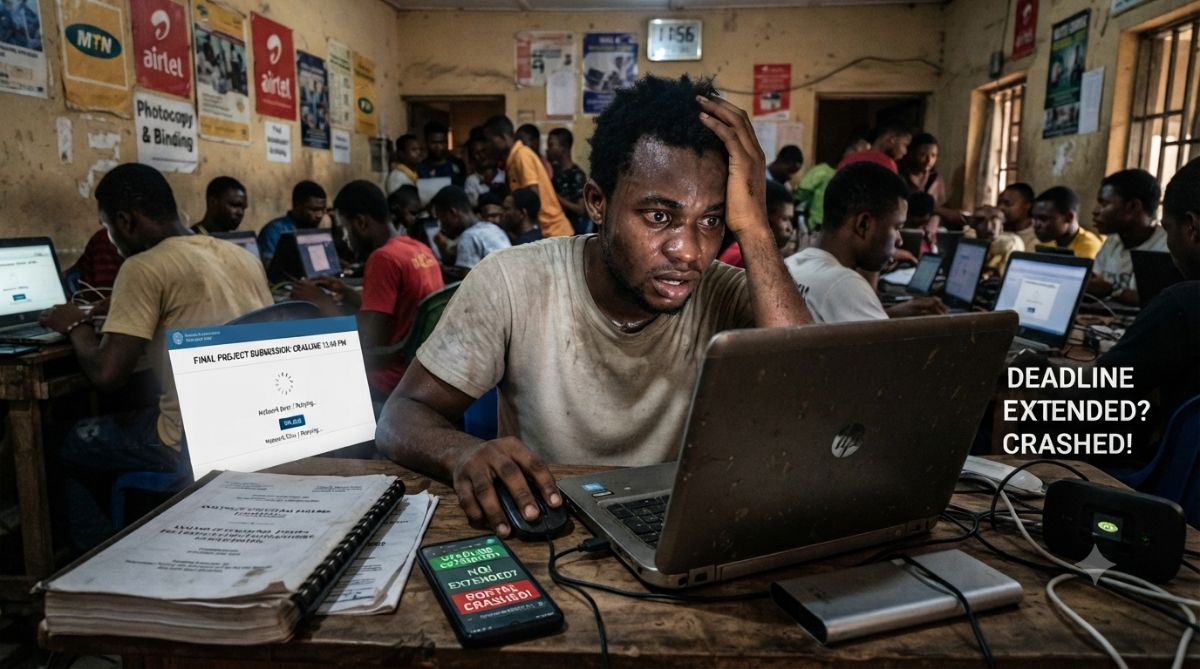
When I got to the nearest café, it looked like the entire school had the same idea.
Students filled every chair.
Some were standing.
Some were praying.
One guy kept refreshing the same page every five seconds.
Another student was arguing with the café attendant as if he personally controlled the internet.
After waiting what felt like forever, it was finally my turn.
The attendant connected my laptop to his faster network.
We clicked Upload.
Nothing.
He sighed.
“The network is slow everywhere today.”
Those words nearly finished me.
I checked the time.
11:47 a.m.
My heart was beating so loudly I could hear it.
I started imagining all the worst-case scenarios.
What if I missed the deadline?
Would I repeat the course?
Would I delay my graduation?
How would I explain it to my parents after everything they'd sacrificed?
I whispered a quick prayer.
“God, please. I've done my part.”
A few minutes later, the screen changed.
The progress bar finally started moving.
10%.
35%.
67%.
89%.
100%.
Submission Successful.
I stared at the screen for a few seconds just to be sure it wasn't lying.
Then I smiled.
Not because I was excited.
Because I was relieved.
The kind of relief that makes your shoulders suddenly feel lighter.
Walking back to my hostel, I laughed at myself.
Just an hour earlier, I had been convinced my academic journey was about to end because of poor internet.
Looking back now, it's funny.
But in that moment, it didn't feel funny at all.
University has a way of teaching lessons that aren't written in any textbook.
It teaches patience.
It teaches resilience.
It teaches you to prepare for things that can go wrong.
And if you're studying in Nigeria, it also teaches you one important rule:
Never wait until the last minute to submit anything.
Because your biggest obstacle might not be your project.
It might just be your network provider.I think this version will resonate strongly with Nigerian readers because almost every student has experienced poor internet, overloaded school portals, or the frantic rush to a cyber café before a deadline.
.jpeg?alt=media&token=96b327a5-8e62-4ed1-a078-308aff149ed1)