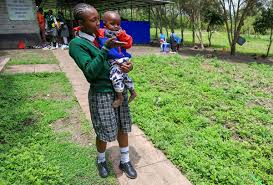
On a dusty plain in Kajiado County, Greenland Girls School has quietly redefined what a boarding school can be. Here, the morning rush to class includes not only uniformed teenagers but also the soft cries of infants carried on their mothers’ backs or cradled in their arms.
The school was created for girls who became pregnant while still in primary or secondary school and were pushed out of the classroom, often by stigma as much as by circumstance. Many arrive after being rejected by relatives or pressured into early marriage. At Greenland, they find dormitories designed to house both students and their babies, and timetables that weave together lessons, childcare and rest.
Kenya’s laws allow girls to return to school after giving birth, yet implementation remains uneven. A study by the Population Council found that about two-thirds of teenage mothers drop out permanently, losing the chance to complete basic education and limiting their economic prospects. Educators and activists say that without targeted support, the promise of “re-entry” is little more than a policy on paper.
Greenland Girls School attempts to close that gap. Teachers are trained to address the academic setbacks that come with months or years out of class, while counsellors help students navigate trauma, shame and family conflict. The school also works with local health facilities so that babies receive vaccinations and regular checkups, and mothers get reproductive health information to avoid repeat pregnancies.
The need is stark. Recent national data show that more than 125,000 babies were born to girls under 19 in Kenya in a single year, a figure that alarms health and development experts. Early motherhood is closely linked to school dropout, poverty and heightened risks of gender-based violence.
Specialized institutions like Greenland are still rare, but they offer a model for how education systems can adapt to the realities of adolescent girls’ lives. By allowing students to study for national exams while caring for their children on campus, the school challenges the notion that motherhood and schooling are mutually exclusive.
For the young women who pass through its gates, the impact is measured not only in test scores but in restored ambition. Each completed term, each exam sat with a baby napping nearby, is a step toward a future that once seemed closed to them.