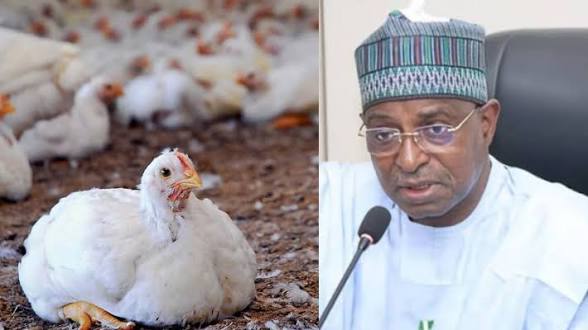
The Federal Government has unveiled a 350,000 dollar partnership with the Food and Agriculture Organisation to boost Nigeria’s capacity to prevent, detect and respond to Highly Pathogenic Avian Influenza, HPAI, amid renewed outbreaks threatening the country’s poultry industry.
The initiative, implemented under the FAO Technical Cooperation Programme, is anchored on the One Health approach, which links animal, human and environmental health. It will focus on strengthening disease surveillance, improving laboratory diagnostics, sharpening risk communication and tightening coordination among key institutions.
Minister of Livestock Development Idi Maiha said the intervention targets a sector that is central to food security, jobs and rural livelihoods but remains highly vulnerable to transboundary animal diseases.
He noted that bird flu has persisted as a recurring challenge since it was first detected in Nigeria in 2006, with a resurgence from 2021 dealing fresh blows to farmers across commercial, medium and backyard operations.
Maiha warned that unchecked outbreaks undermine national protein supply, wipe out investments and shut Nigerian poultry products out of regional and global markets. He stressed that the new project is expected to help close gaps in poultry product supply and support the recovery of affected producers.
The ministry’s Permanent Secretary, Chinyere Akujobi, represented by Chief Veterinary Officer of Nigeria Samuel Anzaku, said Nigeria continues to record annual HPAI outbreaks despite earlier control efforts. She explained that the disease now affects multiple bird species, but layer farms remain the hardest hit, with cascading losses along feed, input and processing chains.
FAO representative Otto Muhinda said the organisation is backing Nigeria to build a more resilient poultry sector capable of withstanding future shocks. Over the next nine months, the project will train 240 animal health personnel, creating a stronger frontline workforce for early detection and rapid response.
The programme will also support the development of predictive tools to anticipate outbreaks and guide targeted interventions. Seven pilot states will benefit from upgraded surveillance systems, enhanced biosecurity, better-equipped laboratories and faster emergency response mechanisms.
Stakeholders from the security, health, veterinary and environmental sectors underscored that only coordinated action can contain bird flu, protect livelihoods and safeguard public health, particularly against dangerous strains such as H5N1 that can occasionally infect humans.
.jpeg?alt=media&token=96b327a5-8e62-4ed1-a078-308aff149ed1)