South Africa has repatriated 2,745 foreign nationals in the space of a week, following President Cyril Ramaphosa’s pledge to intensify action against illegal immigration, Home Affairs Minister Leon Schreiber has confirmed.
The country, one of Africa’s largest and most diversified economies, has long drawn migrants from across the continent seeking work in its mines, farms, factories and informal sector. Many arrive legally, but a significant number overstay visas or cross borders without documentation, feeding a fraught political debate over jobs, crime and social services.
With unemployment stubbornly above 30 percent, periodic waves of anti-immigrant unrest have become a grim feature of South Africa’s social landscape. In recent weeks, groups of residents armed with sticks, whips and makeshift shields have marched through some communities, demanding that undocumented foreigners leave by the end of June.
Businesses owned or staffed by migrants have been looted, and foreign nationals attacked, prompting several African governments to organise voluntary repatriation for their citizens. Nigerians, Malawians, Ghanaians, Zimbabweans and Mozambicans are among those opting to return home.
Schreiber said authorities were tracking departures daily. “As of last night, the number we can report is 2,745 repatriations that have come in this period since the president spoke,” he told reporters, describing the figure as “a moving target” as more people register to leave.
Officials say most of those repatriated were in the country without legal status. A large share are Malawians, including some of the roughly 7,000 people who have been living in an open field in Durban after fleeing threats and violence.
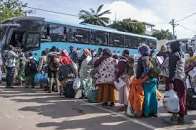
Eight buses chartered by the Malawian government began transporting its citizens out of South Africa, with Pretoria adding 10 more buses to accelerate departures, according to an inter-ministerial migration committee.
At the departure point, families queued with small bags and children strapped to their backs. “I’m relieved we are finally leaving. It’s better than living in fear here,” said Fortunate Chilenje, a 25-year-old from Blantyre who had spent three years in South Africa. She said intimidation continued even inside the makeshift camp.
Another passenger, Laina Nala from Mangochi in southern Malawi, said her only request was to be dropped as close to home as possible. “Blantyre is too far and expensive from there,” she said.
For 27-year-old Hassan Hasha, the journey home is overshadowed by debt incurred to reach South Africa. He had been in the country only a few weeks before tensions flared. “I have resigned myself to going home,” he said.
Ramaphosa has acknowledged widespread frustration over illegal immigration but warned that the state will not tolerate vigilante action. Tensions spiked after a march against undocumented migrants in the Western Cape town of Mossel Bay was followed by the killing of Mozambican nationals. South African authorities reported two deaths, while officials in Maputo said five of their citizens were killed.
South Africa’s statistics agency estimates that more than three million foreign nationals live in the country, about 5.1 percent of the population, underscoring how deeply migration is woven into its economy and society even as political pressure to curb it intensifies.