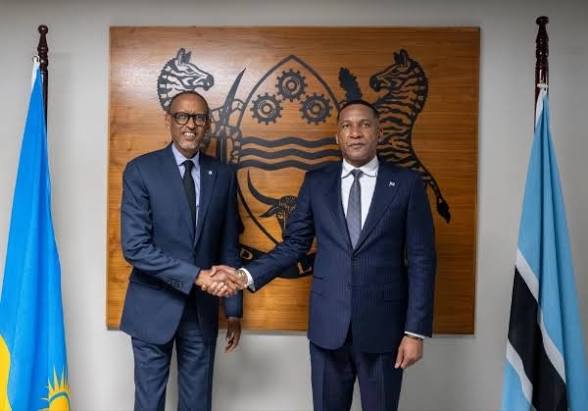
Rwanda and Botswana have concluded six cooperation agreements that both governments say will anchor a new phase of political and economic partnership between the two countries. The deals span aviation, tourism, education, transport, agriculture and broader trade facilitation, signalling a deliberate push to turn cordial relations into concrete joint projects.
The agreements were signed during a state visit by Rwandan President Paul Kagame to Gaborone, where he held talks with Botswana’s President Duma Boko and senior government officials. The visit included bilateral meetings, sector-specific discussions and engagements with business leaders from both countries, according to official statements and regional media reports.
President Boko framed the new partnership as a two-way exchange of experience and capacity, highlighting Rwanda’s reputation for digital innovation, public sector efficiency and post-conflict reconstruction, and Botswana’s long record of political stability and prudent economic management.
Botswana has a lot to learn from Rwanda, and Botswana has few lessons of her own to impart to Rwanda, he said, adding that the agreements were rooted in practical cooperation rather than symbolism.
Boko said the talks covered education, health, agriculture and food security, youth empowerment, sports development, employment creation, infrastructure development and regional connectivity. He argued that closer collaboration in these areas could help both countries diversify their economies, create jobs and strengthen resilience to external shocks.
President Kagame described the relationship as one driven by shared priorities and a common vision for Africa’s integration. He stressed that the new agreements are intended to remove barriers that have historically limited investment and the movement of people and goods between the two nations.
What defines the relationship with Rwanda and Botswana is not only friendship but also a shared sense of purpose, Kagame said. He pointed to cooperation on air connectivity, visa facilitation and double taxation as examples of efforts to create a more predictable environment for investors and entrepreneurs.
Regional analysts note that enhanced air links and streamlined visa regimes could position both countries as more attractive hubs for tourism, conferences and financial services, while agricultural and education partnerships may support food security and skills development.
Kagame’s visit is also seen as reinforcing a broader trend of African countries seeking deeper South-South cooperation, using bilateral agreements to complement regional and continental frameworks on trade and integration.