I didn’t plan to end up in the state i was posted for NYSC.
When my posting letter came out, I remember staring at it for a long time, like if I looked hard enough it would change. It wasn’t Lagos, it wasn’t Abuja, it wasn’t anywhere I had mentally prepared for. It felt like my plans had been quietly reset.
I got there with the usual NYSC mindset—just survive the year, collect the ₦77,000 monthly allowance, and figure out life after service. Nothing deep. Nothing ambitious. At least, that’s what I told myself.
The first few weeks were just orientation camp life: early morning drills, shouting platoon commanders, heat, boredom, and small conversations with other corps members who were also pretending they had everything under control.
Then SAED started.
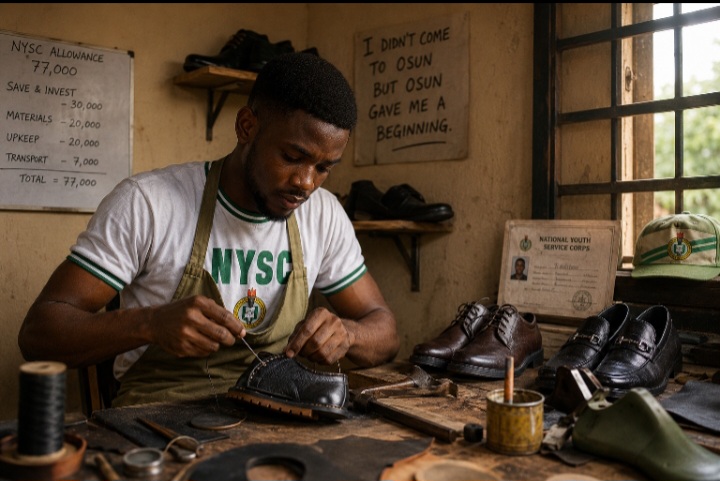
At first, I didn’t take it seriously. It sounded like one of those NYSC programs you attend because you have to, not because it changes anything. But I still went for the shoe-making training anyway. I didn’t even know why.
That decision quietly changed things.
The first time I held the leather and tried to cut it properly, I realized it wasn’t as easy as it looked. My hand was shaky, my cuts were uneven, and my first attempt honestly looked like something that should not be worn by any human being.
But I kept showing up.
While others joked through the sessions or skipped when they got tired, I stayed. I learned how to measure properly, how to stitch without rushing, how to finish a shoe so it actually looked like something someone would pay for.
Then the allowance started coming in.
₦77,000 every month sounds like a lot until you start breaking it down—food, transport, data, small emergencies, and the general “Lagos brain” habit of spending even when you shouldn’t. But this time, I made a decision I didn’t overthink too much: I would not spend everything.
I started setting aside part of it.
First ₦20,000. Then ₦30,000. Sometimes more when I managed to control myself. I used it to buy basic shoe-making materials—leather, glue, threads, a small cutting tool I still remember struggling to afford.
My evenings changed.
After CDS and normal NYSC routines, I would sit down and practice. Sometimes alone. Sometimes frustrated. Sometimes wondering if I was wasting my time. But I kept going anyway.
My first real “customer” was another corps member.
He laughed at my suggestion at first. “You? Shoe maker?” But he gave me his old sneakers anyway, maybe out of pity or curiosity. I fixed them. Not perfectly, but better than expected.
That was the beginning.
One person told another. Then another. Slowly, I started getting small requests—repairs, adjustments, simple slippers. Nothing big, but it mattered. Especially to me.
There were moments I messed up badly.
I remember one pair that came out completely wrong. I had to refund the money even though it hurt my pocket. There were days I questioned why I didn’t just spend all the money on comfort like everyone else and enjoy the year quietly.
But something kept me in it.
Maybe it was the fact that I was finally building something with my hands. Something real. Something I could see.
By the time NYSC was ending, I wasn’t the same person who arrived 11 months ago.
I had a small setup, a growing list of people who knew my work, and a skill I could actually use. The ₦77,000 allowance that once felt like survival money had quietly become my startup capital.
When I folded my khaki at the end of service, I didn’t feel like I was just “done with NYSC.”
I felt like I was just getting started.