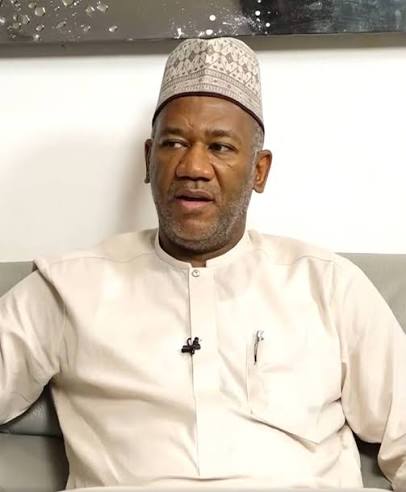
Yusuf Datti Baba-Ahmed, the Labour Party’s vice-presidential candidate in the 2023 general election, has renewed his call for a generational shift in Nigeria’s political leadership, using his long-running encounters with former Vice President Atiku Abubakar as a symbol of the country’s stalled political evolution.
Speaking during a televised interview, Baba-Ahmed reflected on how Atiku’s repeated presidential bids have spanned virtually his entire adult life, arguing that the persistence of the same political figures at the top of national contests is a sign of deeper structural problems in Nigeria’s democracy.
“When I was doing my NYSC, Baba Atiku was an aspirant,” he recalled, drawing a contrast between his own early years of public service and Atiku’s already established political ambitions. “And in 2018 we contested primaries together.”
Baba-Ahmed, an economist, former senator and founder of Baze University, noted that their paths crossed again in the 2023 elections, when he ran as the running mate to Labour Party presidential candidate Peter Obi, while Atiku flew the flag of the Peoples Democratic Party.
“In 2023, we contested again. I, as a vice president elsewhere, when his vice president had left him. And for God’s sake, in 2027 again?” he said, in a pointed rhetorical question that underscored his frustration with what he sees as a closed and repetitive political field.
For Baba-Ahmed, Atiku’s longevity in presidential contests is not merely a personal issue but a metaphor for a system that recycles the same personalities while shutting out a broader pool of capable Nigerians. He argued that the country’s political space has become so constricted, expensive and manipulated that many qualified citizens simply opt out.
“There is need for a new generation of Nigerian leaders, and they do exist,” he insisted. “A whole new generation are waiting for a new leader to lead them to a new party.”
He described this emerging cohort as educated, globally exposed and deeply frustrated by the state of governance, yet largely disconnected from the formal political process. According to him, these Nigerians are not apathetic; they are disillusioned by a system that appears designed to keep them out.
Baba-Ahmed painted a bleak picture of the current political architecture, characterising it as a terrain dominated by entrenched interests and transactional politics. “There are good Nigerians, people capable of solving Nigeria’s problems, but they are discouraged by the expensive, difficult, treacherous system full of godfathers and bad promises,” he said.
He argued that the cost of seeking office, from party nomination forms to the informal financial demands of political godfathers, has turned elections into a high-stakes investment rather than a service-driven calling. This, he suggested, explains why many of the country’s brightest minds prefer careers in the private sector, academia or international organisations instead of contesting for public office.
Baba-Ahmed’s comments also touched on recent speculation about his own political future. Reports had circulated suggesting that he had already declared an intention to run for president in the next election cycle. He dismissed those claims as false, stressing that his current focus is on advocating systemic reform and credible leadership rather than announcing any personal ambition.
He maintained that Nigeria’s salvation does not lie in the ambitions of any single politician, but in the emergence of a new political culture that rewards competence, integrity and ideas over money and patronage. In his view, the country’s recurring crises – from insecurity and unemployment to inflation and institutional decay – are symptoms of leadership failure, not destiny.
While he did not name specific individuals he believes could embody this new generation of leadership, Baba-Ahmed insisted that they are already present across the country, waiting for an opening. “Many competent Nigerians are waiting for credible leadership to help fix the nation’s problems,” he said, suggesting that a catalytic figure or movement could unlock a wave of participation from currently sidelined citizens.
His remarks also implicitly revisited the 2023 election, in which the Labour Party’s campaign drew significant support from younger voters and urban professionals who were disenchanted with the dominance of the two major parties. Baba-Ahmed framed that moment as evidence that Nigerians are willing to rally behind alternatives when they perceive them as credible and principled.
However, he warned that without structural changes – including internal party democracy, campaign finance reform and the weakening of political godfatherism – the system will continue to reproduce the same outcomes, regardless of public sentiment. The repeated appearance of familiar names on presidential ballots, he suggested, is a symptom of that deeper malaise.