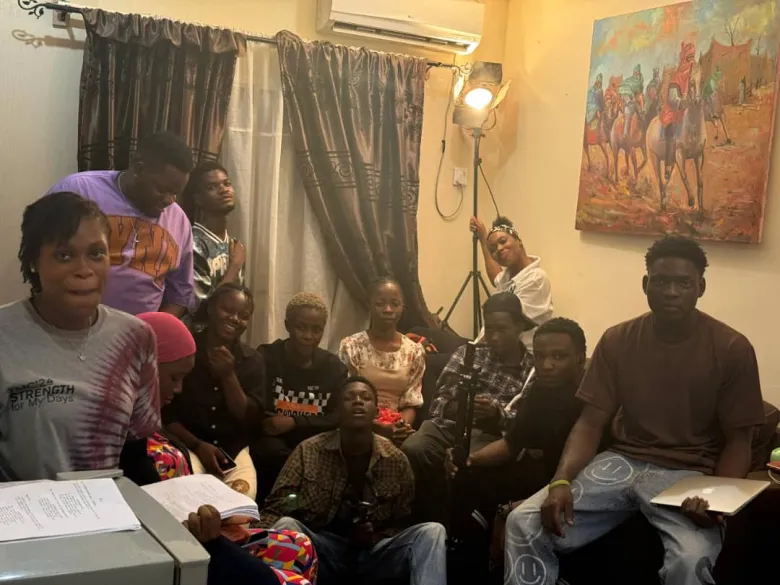
When people watch a film, they see the final magic: the actors, the camera angles, the soundtrack.
But what they don’t see is the costumiers — running around with fake blood, wigs, worn-out bags, and pins, asking: “Does this look real enough?”
Unspoken is our capstone project.
So far, we’ve only filmed two scenes: the house scene (when Femi was a boy) and the classroom scene (when he’s older, at university).
But these two scenes alone taught us so much — and they came with their own share of laughter, stress, and small arguments.
🏠 The house scene: blood, bruises & the stubborn wig
In the house scene, we show the violence in Femi’s home when he was still a child.
Our job as costumiers was to make the mother look believably hurt — not fake, but real enough to make people feel it.
We used fake blood carefully: dried stains on her cheek, fresh streaks on her arm, small bruises on her face.
But the real struggle? Her wig.
At first, it looked too perfect — like she just got back from the salon.
We joked: “Aunty, abeg, suffer small o!”
In the end, we loosened it, added subtle blood, and made it look slightly scattered — to show what she was going through at home.
🎒 Young Femi: uniform, hearing aid & worn-out bag
In this same house scene (the flashback), young Femi appears in his school uniform.
We paid close attention: the uniform had to look neat (because his mum cared for him), but not brand new — to reflect their middle-class life.
He also had a hearing aid in the script.
We added small fake blood around his ear to show the pain of the violence at home, and how it affected even the way he heard the world.
The schoolbag was another detail: slightly worn-out, a bit old — not because they were poor, but because it told the silent story of a boy living through chaos.
Sometimes, it’s the little things — a bag that’s a bit torn, or a stain on a sleeve — that speak louder than words.
🏫 The classroom scene: older Femi, casual clothes & real-life tension
The next scene we shot was when Femi was older, at university — so, no uniform here.
He just had casual clothes: simple, muted colours to show his quiet, withdrawn personality.
We kept his clothes slightly plain, to contrast characters like Itunu, who we styled to look effortlessly pretty — natural makeup, soft lips, and a simple look that still turned heads.
We also kept Femi’s old bag from the flashback — now looking even older and more tired — to show that even though he grew up, he still carried the weight of his past.
⚡ Arguments, exams & behind-the-scenes reality
What people don’t see is the real behind-the-scenes.
We had moments where we were so tired, someone said:
“Abeg, let’s continue after exams. Capstone or not, we never read!”
But the director pushed us to keep going.
We had arguments about the wig, the blood, the timing — small things that felt big in the moment.
At one point, it felt like we were all just saying: “Abeg, e don do!” — but somehow, we always came back together.
✂️ Why costumes matter
Costumes are not just clothes.
They show pain without words.
They reveal if a character is messy, broken, or still trying to hold themselves together.
From young Femi’s slightly neat uniform (a mother’s love) to older Femi’s plain clothes and worn bag (silent trauma) — every choice meant something.
Even the mother’s messy wig told a story: that behind her neat life was pain no one saw.
🎬 Just the beginning…
We’ve only shot the house scene and the classroom scene so far — but those two scenes already felt like a full journey.
Fake blood on our hands, joking about wigs, arguing over bag choices, and worrying about exams — that’s real
Next time you watch a film, look beyond the lines.
See the clothes, the blood, the old bags, the small details — and know there’s a team behind it, telling silent stories.
Unspoken isn’t finished yet — but we can’t wait for you to see it 😌❤️